Showing posts with label "resource pile". Show all posts

Monday, October 22, 2018

La Misma Luna: Resources for the Spanish Classroom

Oh hey! Remember me?

I fell off the blogging bandwagon because I got too devoured by teaching to do much reflecting or sharing. (I still have managed to reflect on the end of my teaching at the end of each year, however... year 10 is in the bag!)

After teaching Spanish for years, I've transitioned into a new role at a new school, so this blog may adapt with me.

For now, however, I wanted to share some resources for the movie La Misma Luna, since some teachers were asking for resources on Facebook.

I love this movie. A student recommended it to me years ago in Detroit and ever since I've watched it with a wide range of 5th-8th grade students. I haven't had a single student not like it. Even the grumpy ones. More than that, it personally has held up to many, many viewings. I still enjoy watching it with my students and still cry every time. It's become even more meaningful since moving to a border community, with border and immigration issues prominent in the news.

Bonus: Want some easy sub plans that would work for almost any grade level and language level? Use this movie. If you need a last minute solution, here's a pretty generic packet that should last two class periods... because we've all been there. If you are not in the desperation stage of throwing together sub plans while deathly ill, keep reading and customize this for your particular students and program.

(Not quite) Spoiler Alert: This scene elicits screams every single time.
It's also at a perfect cliffhanger spot to stop. Soy cruel. ;)

Stats:

1 hour and 49 minutes. If you have hour long classes you can squeeze it into two. I almost always use 3 or 4 class periods. so we have time to talk about the movie, do follow up with vocab, and so on.

Access to the movie:

This movie was on Netflix for a while but as of this post it is not. You can buy the DVD on Amazon (if you use that link, I'll get a few cents) or borrow it from your library. Personally I think it's worth having a copy. I've used that DVD more than any other over the years. I strongly suggest not buying the video streaming via Amazon, as you don't have the same language controls. 

(If Amazon fixes this or you know of a way to adjust language settings on Amazon streaming, let me know!)


Parental concerns:

The movie is rated PG-13. For students younger than 13 I send home something like this. I've only had one parent ever not want their kid watching the movie. (I have a collection of alternative materials, in case.) Here's more info from Common Sense Media.


Activities:

In the olden days I used to have students answer comprehension questions, but eventually I found that I didn't need comprehension questions to keep students focused on the movie. I preferred to target language and culture, so switched to doing activities that connected to specific language objectives and needs for each class. Here's a bunch of activities that I've used. Usually I just print out relevant pages for a packet, or print out a variety of combinations for less homogenous levels. (For example, for a description of scenes and characters have several different versions for different levels, marked by chili peppers depending on how "spicy" they are.) Use whatever works for you!

The alternate endings is the newest addition to this collection of activities and has been the most fun, because it allowed students to use the energy and outrage that is always generated by the ending of the movie (no spoilers!) Even the most beginner students could use the language to get creepy and weird. (¡Carlitos y Rosario se casan! Rosario trabaja para la migra!) You could definitely adapt this to grammar structures your students are using.

More resources:


  • Superman es ilegal - Follow up activity with a song by Los Hermanos Ortiz from the movie. 
  • A las tres - Activity with another song by Los Enanitos Verdes (with a related theme of family and immigration.) 
  • A few different Quizlet sets related to the movie (I like playing a quick Quizlet Live as a way to review or preview vocabulary. 
  • Practice test for the questions asked in a naturalization interview. Can you and your students pass?
  • If you have PearDeck, use it for students to describe characters.


Friday, December 30, 2016

Soy Yo

At this year's most recent middle school dance, I asked the DJ to play this song. When it came on, the kids screamed and started flailing around. (As much or even more so than for the previous Whip/Nae Nae, if I might say with a fair amount of pride.) Seeing the kids dance and sing along in Spanish was one of my high points as a middle school teacher. 


Here are some resources I have used with this song:
  • Reading Activity (adapted from this article about Sarai, the girl in the video)
  • Lyrics Training activity using Soy Yo (to sing karaoke or do a listening activity)
  • Lyrics activity from Zachary Jones from his ebook, Cancionero 2015 - I use many of his activities (both free and purchased) and any of his ebooks have been well worth the money.
  • Speaking of Zachary Jones, he has a great series of interviews called ¿Cómo eres? None with little Sarai yet, but one can hope. I used these as a somewhat independent listening activity and students liked them so much that I added it as an option to our monthly homework options.
  • Another related song was Como soy by Manu Manzo, who does have a ¿Cómo eres? interview.
7th grade in particular has been a little obsessed with this song (I've caught kids singing it in the halls, and heard rumors that kids brought it up during some recent restorative circles in morning meetings.) I'm using some of that energy to kick off our 2nd trimester project about language & identity, connected with a skills unit on descriptions. More to come on that, hopefully.

Related resources bumping around in my files:
  • Eres by Café Tacvba is another song I've used to introduce or review the conjugation of ser. Not quite as catchy as this one, but the kids still mention "that creepy black and white song.") 
  • A few years ago (in my first dabblings in PBL) I had students find a song of their choice and use the lyrics to search for targeted grammatical structures. Here's my first attempt at that mini-project, which I may revisit.
Big Picture: Grammar & music

I'm still struggling to balance PBL and proficiency, especially when it comes to grammar & conjugation, but using music is one thing that has been consistent through my evolution as a teacher. Songs were what kept our heads above water during my early years of treading water in Detroit, as I gathered a collection of songs that drove my K-2 curriculum and used music (including the only alphabet song I can stomach) to engage some of my most challenging middle school classes. As I learn more about project based learning and how to let students learn by doing, music has been a great resource for experiencing verbs in their natural habitat. If a song is catchy enough the grammar structures will stick in students' heads, and if it is repetitive enough it can allow for some "DIY" grammar rules based on observations of repeated patterns in a song.

Finally, anything that makes students spontaneously yell things in Spanish I'll count as a success in the complicated, often-grumpy land of middle school language teaching.

Thursday, February 19, 2015

El Carnaval: A resource pile

President's Day, the Lunar New Year, and Carnival were all jumbled together at the beginning of this week.

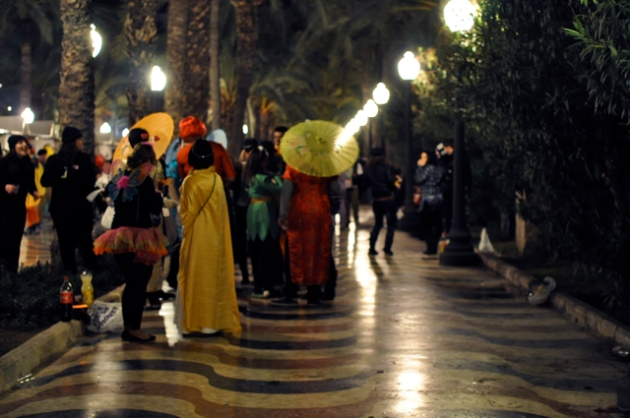
El Carnaval en Alicante, España.

My middle school classes have been working hard on other projects, so I wanted to create a somewhat independant exploration for students who were done with their projects, or for extra credit in some classes. Our schedule is a little messy right now after a 4 day weekend, so this was a fun "filler" to help get all the classes caught up.

Carnival/Carnaval/Mardis Gras is a truly multicultural topic of exploration, and there are so many great examples of colonized cultures combining (or disguising) their beliefs with newer Catholic traditions. It's also a good example of some traditions that are fun enough on their own, even without the complex historical background behind them!

This might be belated for this year, but I wanted to share some of the resources I used this year related to El Carnaval! Here is a leveled list separated by learning style, with resources in both English and Spanish.


I gave this list to my students directly, along with this paper. They could choose which resources they used to find the answers to the questions, according to their language level, learning style, and interests.


(I went paperless with some classes by creating a Google Form of these questions, too - I can share the template with you if you wish. Feel free to contact me!)

Do you have any more great resources related to Carnival? I am especially interested in expanding my knowledge of celebrations in Latin America - my only personal experience is from Spain and my own Catholic childhood.

Sunday, November 2, 2014

Recordatorios Musicales: Music Cues

I've been trying to use music a lot more in my classes, especially with middle school. I've been structuring lessons, reviews, and assignments around music, as well as incorporating it into classroom management.

I was inspired by one of my coworkers, who is using music cues for math class. She uses popular theme music from television shows, played through this app. The app is nice because its designed for the classroom. (It doesn't automatically play the next song on a playlist, and you can set a specific time for the cue to begin.)

Here are the musical cues I've been using in my middle school classes, including links to the songs and the specific clips: Musical Cue Playlist. Most of these are from songs that students turned in as part of a project this past quarter, which helps with student buy-in.
  • La Vida es un carnaval - Celia Cruz
    •  Transition to groups. (20 seconds.)
  •  Te extraño - Xtreme.
    • End of class: Write down homework, get ready to be dismissed. (51 seconds.)
  • La Tortura - Shakira.
    • Get out homework, staple as needed, turn in to the correct folder. (1 minute, 22 seconds.)
  • Pa' Bailar - Bajofondo y Julieta Venegas.
    • Shut down computers and put away laptops according to our class procedure. (3 minutes, 36 seconds.)
Most of the lyrics are pretty carefully chosen, mostly because I think I'm hilarious. (Por supuesto, la tortura es la tarea... y no de excusas vivo yo.)

On that note, if anyone can rewrite La Totura to specifically be about lost homework, they will be my personal hero. (Fue una tortura.... perderte.) If I can get one of my students to take this on as a project, I will consider the year a success.

Technical tips:

I use Youtube and Dirpy to create clips from specific bits of the songs, but there are plenty of other similar tools out there, for all platforms. If you do use Dirpy, make sure you use the correct buttons. It is a free and ad-supported site, so it's easy to accidentally click ads.


Sunday, October 26, 2014

Día de los Muertos: Resources

This is one of my favorite seasons with my students, and I have a feeling that this year I will be learning even more than I teach. As a newcomer to San Diego, I am excited to see some local celebrations, and to get input from my students who have celebrated this holiday with their families.

Here are some of the things I have done with my students in the past, and some things that will be included in my lesson plans for this week.

Let students explore some of the sights and sounds of the holiday.

el día de los muertos

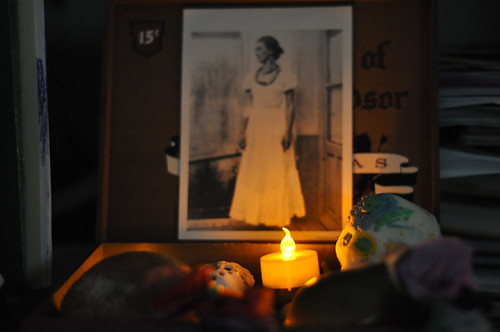
I love the opportunity to hook students with something mysterious. As a traveling elementary teacher, in past years I have put together a mini portable altar in a wooden cigar box, with a picture of Frida Kahlo (a favorite figure that most of my students learn about at some point in their time with me.) I light the "altar" with battery operated candles, and the flicker of yellow light from inside a closed box gets everyone's attention. Usually I extend the suspense and leave the box closed until we have explored some resources together, and then I will invite students to gather around and look at what is inside the box (photos, candles, flowers, sugar skulls... all things they just saw in a book or video.)