Showing posts with label project based learning. Show all posts

Sunday, February 5, 2017

La Señora toca el ukulele: PBL and language learning outside the clasroom

If I've learned anything in almost a decade of teaching, it's that I'll never stop learning... and although I don't think I've ever lost track of how to be a language learner, it's still easy to lose hold of what it feels like to be a beginning language learner. As we are deep into conjugation practice in 8th grade, I see novice students and native speakers alike baffled by the mysterious jumbles of pronouns and verbs. After approximately 15 years of pounding those verbs into my head, it's easy to forget how confusing they first were.

One of the things I've been pushing myself to do this year is to learn new things. This is part of my ongoing and often futile quest for work/life balance, but also pretty crucial as an educator. It's harder to empathize with my students and give them the support they need if I forget what it is like to be a learner.

Here's what I'm learning and what I'm re-learning about about being a learner:

Arabic: I began learning Arabic a few years ago. In reality it's been about a decade... but with nothing more consistent than a year or so of (supposedly) weekly language lessons, which were more like monthly or semi-monthly. I tended to switch into Spanish as my default L2 mode. I used the strategies and tricks I taught my Spanish students - I labeled items in my house, made flash cards, came up with mnemonic devices, and drew things on whiteboards. During my year teaching English in Spain, I found a Spanish/English/Arabic exchange in order to rediscover my language-learning self as I was embarking on the new adventure of teaching my native language.


I learned what my students (hopefully) have learned - if you don't put in time to practice and study, you won't be able to use the language. Some words stuck - the word for thank you (because I drew a picture to go with it, and because I could actually use it in the real world) and the word for worm (because of the little worm dude/dood I drew.) (Okay. That is totally a caterpillar. Apparently I have a lot to learn.) By the time I actually traveled to Morocco, the only full sentence I could remember was "She drinks coffee." Not super functional.

Now I'd like to pick Arabic up again, especially in our current country's situation, where I am trying to engage with and fight for those who are oppressed and under-represented. (That's another story.) I know the drill - I need to practice every day. I need to learn phrases I can actually use, and find places to use them. I know how to be a language learner. (Now let's see if I can carve time for being a language learner out of the massive amount of time it takes to be a language teacher.)

Maybe I'll set myself the same monthly homework requirements I give my students, and they can grade me.


I'm also trying to learn the ukulele. A few months ago I somewhat impulsively bought a ukulele. Now I've been muddling my way through learning how to play it, usually on sunny Saturday mornings. I have limited musical experience, and only with melodies on very linear instruments (Celtic harp, mountain dulcimer, piano) so there's a steep learning curve! I am starting by trying to learn Limón y Sal by Julieta Venegas, starting with this tutorial.

I'm learning from a Spanish tutorial, and learning a new skill in my 2nd language is great in the context of project based learning. It's made me realize a few things about a second language + PBL. To learn to play the ukelele, I obviously needed to understand enough of the tutorial to follow along. I needed a basic level of language in order to learn a new skill in that language. That allowed me to follow along, and learn more specific new vocabulary in an authentic way. (Acordes and traste I could understand from the context. Rasgueo I could understand, and looked up to learn the new verb rasguear.) Chord charts are confusing to me because I have trouble conceptualizing spatial information. I watched the beginning of the tutorial several times and drew out charts of the fingering, but couldn't get all the chords to sound right. I re-tuned the ukelele a few times, downloaded a app for chords, watched the video a few times. I eventually realized I was holding the ukulele in the wrong hand. I needed to grab the white-out and start over several times. I needed to be okay with making mistakes and reassessing what I thought I knew in order to keep going. Once I fixed my hold on the ukulele I could correct my diagrams and actually practice the cords correctly, trying to cement those abstract diagrams into muscle memory.


How does this apply to my teaching?


Students need to have some basic language skills before collaborating and using those skills for a project. This is why this year I'm making sure I focus on skills and proficiency and not sacrificing all of our limited class time for projects - as much as I believe in project based learning as the best way for students to learn, students need proficiency. Especially as we develop and increase our K-5 language program, by middle school students will have both the language skills and the confidence needed to complete real-world projects in the language classroom. Focusing on authentic, engaging language tasks is a way to incorporate the concepts and values of PBL without sacrificing proficiency.

Teaching students a growth mindset and not to be afraid of making mistakes is crucial. Building a safe, supportive environment where students feel safe making mistakes allows them to show up and actually begin the hard work of language learning. For me, a big part of letting kids be vulnerable is letting them see me as a learner as well. From the perspective of a Spanish learner now teaching Spanish, I'm able to share with students my own struggles with the language, and strategies I used to study and remember. As a gringa guiri language learner turned teacher, acknowledging my status as a learner is important - especially in a community that includes native speakers. I often ask native speakers for regional variations or obscure words, and we look up words together frequently. Taking a descriptive rather than prescriptive view of language (lo siento, Real Academia) is also important, since I want students to recognize and respect regional variations as it is used - not just language from a book or the variations I happened to encounter in Spain. Finding the best way to support and challenge my native speakers is an ongoing area of growth for me, but the importance of beginning with a respectful and supportive relationship is one thing I'm already sure of.

Sunday, December 18, 2016

Zines: ¿Por Qué Aprender Idiomas?

I haven't kept up with blogging this year. Even though my schedule is a lot more reasonable (I'm only teaching 5th-8th!) somehow there still isn't time for much other than just teaching. However, we just began our 2 week holiday break, and before jetting off to the Midwest I took some time today to gather some student zines to donate to a local zine library. That was a reminder of a project I've been meaning to share here - our zine project in September!

Saturday, March 12, 2016

Proyecto: Mi Lotería Personal


We just started a project in 6th grade that has already been a lot of fun, using La Lotería Mexicana. I already knew I wanted to use it as a way to reinforce articles and the gender of nouns in a fun and hands on way, but while muddling through the PBL project design process and trying to connect that to the expensive curriculum that was just bought for me this year I realized this could be a good way to wrap up some of the curriculum objectives from Avancemos 1 into a project - specifically, Unit 1 objectives from Avancemos 1. After beginning this project, I already know I need to connect Lotería to more lessons and projects. It's been great to see the student engagement, from both my native speakers and others who have played this game with their families. (Here in San Diego, there's even a local brewery that has Lotería nights instead of Bingo nights.)


Here's our project so far. You can also see my project overview here: tiny.cc/proyecto-loteria-6
  1. We played La Lotería in class using this bilingual student version: Bilingual Bingo / Lotería Bilingue. It's nice for my mixed level class because we can read the rhyme out loud, and anyone who can understand it (usually my native speakers) can call out the word in Spanish. (¡La luna! ¡El sol!)


  2. We looked at a selection of creative Lotería sets in class to glean examples of different types of words. Most of my students were sorting nouns by gender and by type of word (person, animal, etc.) but my native speakers were categorizing words by their stressed syllables. (We've been looking at sílabas tónicas in order to help with correct accents. It's the first time this year I've heard these kids whining that the work is too hard, so I think I've finally manged to find a task at their level!) Here are the Loterías we looked at - albeit selectively. Your use of these Loterías may depend on how comfortable you and your students are with the human body, alcohol use, and racial commentary.)

    1. A traditional set of Don Clemente Lotería cards from a local Mexican supermarket
    2. Lotería Clemente Jacques, 1930s (México)
    3. Lotería Clemente Jacques, 1960s  (México)
    4. Lotería de Posada (Arte de José Guadalupe Posada, 1852-1913) 
    5. Lotería Moderna de Teresa Villegas (This project was a great excuse to buy her gorgeous Loteria book.)
    6. Lotería los Compadres (Moderno de México)
    7. Lotería 50 nombres para la muerte (Erik de Luna, México)
    8. Lotería Huasteca (Art of the Huastec people, Alec Dempster & Arturo Castillo Tristan)
    9. Lotería Star Wars (Chepo Peña)
    10. Lotería de Fotografías de México (Jill Hartley)
  3. We'll also be reading this book, which is a sweet bilingual story. I would start the project with this book normally, but I ordered it right after beginning the project.

  4. We will be creating our own Lotería cards that share something about ourselves. Students will choose objects that represent something about themselves, and the "hints" on the back will be sentences about themselves, using the language skills we have been practicing. I've created some examples, like this card that features a baby teacher with her baby cat.

I can't wait to see what my students come up with! 

(Disclaimer: Links to Amazon products are provided via Amazon's Associates program. I receive some money if you end up buying these products through the ads on this page. I'm grateful for this opportunity through Amazon, but also through their Prime shipping which allowed me to come up with this project and pretty immediately get the books and games I needed  to start it right away with my students!)

Sunday, March 6, 2016

Caprichos Modernos: A cross-curricular Spanish project

One of my resolutions this year was to be more intentional about work/life balance. (Spoiler alert: I resolve this every year.) Starting in January I began using the Tracking Time app to start tracking how much time I was spending on various tasks outside of actual teaching - lesson planning, after school meetings, parent and student emails, grading, updating our gradebook, updating our school website, interpreting IEPs, etc. I don't think I've necessarily spent any less time on school, but I've been able to see where my time is going. (I love getting nerdy with data, so the ability to sort and track data actually acts as a motivator to get things done. This is the only way I convince myself to exercise, too.)

With that said, I could tell you exactly what I've been doing other than updating this blog, and it's mostly been project planning. At my school we've been digging into Project Based Learning pretty intensively during our professional learning time. I already shared my quick translation project that I did with 7th and 8th grade. Recently we've just started another bigger project that I'm pretty excited about. It's a cross curricular advertising project that 7th grade students will be working on in English, History, Spanish, and Math classes (with a heavy dose of Art thrown in as well.) After examining and analyzing messages in Spanish and English advertising campaigns, students are working in marketing teams to create publicity about something they want to change in their community or society. In Spanish class, we are also examining messages expressed through art, with examples ranging from Goya's Caprichos criticizing the corruption and chaos of Spain in the late 1700's to a Tumblr created much more recently questioning the suspicious disappearance of 43 Mexican students in 2014. We'll have a public exhibition for parents and community members at the end of this month. I've already had so much fun looking at ads and art with my students, and can't wait to see what they come up with.

Since I've spent approximately 40 hours to date planning this project (thanks, nerdy app!) I wanted to share it with as many people as possible. I'm gradually adding more links and resources and tweaking the rubric as I go along, but this is where I'm at currently.

Please feel free to use any of this in your own classes! Since this is a new project, I would appreciate any feedback you can give. I've got two other big projects either in progress or about to start (in 8th and 6th grade) so maybe I can share those soon, too.

Proyecto: Caprichos Modernos (7º)

Paso 1: Anuncios en español


Paso 2: Mensajes por el arte


Paso 3 y 4: Mi Capricho 
This is my first time doing this particular project, but in during student teaching I used Goya in a cross-curricular unit where students also created their own modern versions. Here are some of those student Caprichos which I'll be showing as examples:

Saturday, December 19, 2015

A quick translation project and a long reflection

At my school we've been working hard on Project Based Learning (PBL) and how to implement it effectively in our school. There are plenty of school-wide challenges, like constructing quality projects within the constraints of fairly traditional schedules and staffing, and a national educational climate that still requires focus on specific national standards measured by high-stakes tests.

As a language teacher, I've been struggling with PBL and how that fits with what I know about developing language proficiency. Within the constraints of my schedule (two 40-60 periods per week, depending on grade level) I feel like I constantly have to choose my focus:
  • Teaching entirely in the target language or creating student-driven, inquiry-based lessons
  • Project based learning vs. language immersion
  • Creating decent lessons for 6 different grade levels vs. creating a few great lessons
I know I'll get better at this with time, and it helps to be collaborating on PBL with others. I think for now I need to accept slow progress - which is hard for me. I've been averaging 60 hours per week just inside the school building (plus more at home) just planning and grading work that I know is subpar, from a language proficiency perspective. Compromising professional work quality for any kind of work-life balance is nothing new, but I do feel fortunate that I work with administrators who understand our constraints (rather than just creating more) and who are willing to give teachers space to grow within those constraints - there are definitely places where that is not the case. 

All of that to say: I've been thinking a lot about meaningful projects, and getting discouraged because they seem beyond my grasp.

However, one quick project I did with 7th and 8th grade this month was a bright spot... especially because it was the product of a spark of an idea while driving home one night and a few frantic hours of preparations in order to start the next morning!


This year some parents and staff at my school collaborated with a local charitable organization to collect donations of socks and toiletries for those in need in our community. Ideal projects address a real need in the community - which is tricky when it comes to unit planning, since sometimes real community needs don't fit into curriculum maps. I figured that an opportunity to create something real world and authentic was more worthwhile than spending our last class periods wrapping up weather review and holiday-related cultural lessons. So I threw together a translation project that could fit into two class periods. I'm pretty happy with the results - more so than some projects that have taken far more planning and class time.

This is what we did, how I would change this for the future, and maybe even some ideas for you.

Sunday, November 30, 2014

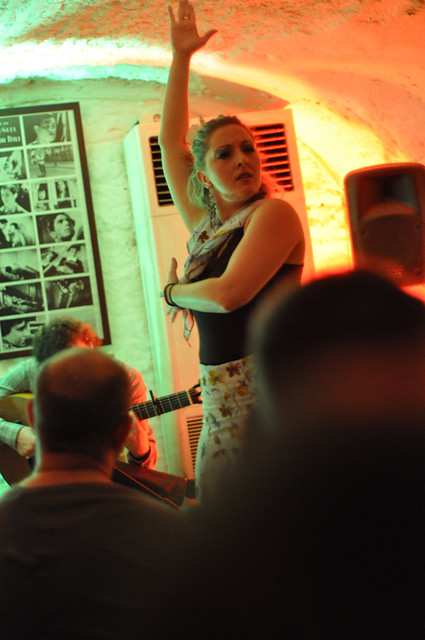
El Flamenco

Granada - Ciudad Encantadora
Flamenco en Granada
On the last day before Thanksgiving break, the 7th graders had dance performances during their morning P.E. class. Our P.E. teacher had students work in groups of 3 or 4 to research a specific style of dance, choose a song, prepare a dance, and practice it to perform. I got to watch a few of these, and it seems like an amazing project.

Three girls researched and performed a flamenco dance. I really wanted to see it, but I was teaching 5th grade and just barely missed the girls' performance, and caught them as they were clicking and swishing to their next class (in very clicky heels and very swishy skirts.) They offered to perform for Spanish class that afternoon, which seemed like a great way to spend the last hour before break. (Not always a time for strenuous academic effort.)

I am envisioning future Spanish-P.E. collaborations on this type of a project, especially for native speakers who could write reports in Spanish, and offer demonstrations that are kinesthetic enough for even more basic levels to understand.

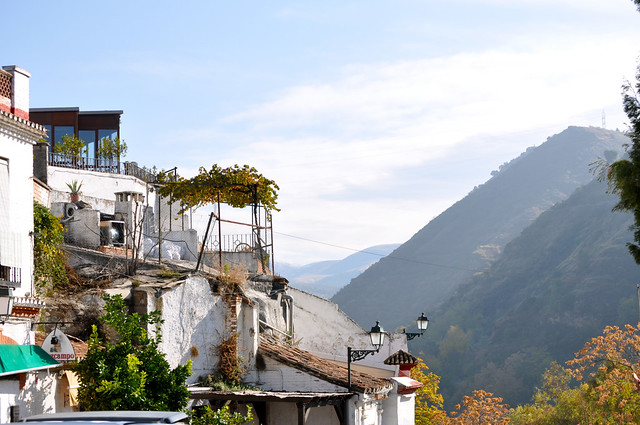
Sacromonte
Sacromonte, Granada, where many caves in the hillside hold homes, shops, and famous flamenco performances.
I've used flamenco as a quick cultural lesson before, so it was a good thing to throw together at the last minute. The girls performed their dance, and explained what they knew about the history of flamenco. (They had to write a paper about the dance as part of the project, and as a result were able to teach me a few things!) We talked about the roles in traditional flamenco, the dialect in Andalucía (cantador vs. cantaor) and the cajón, which is also the name of a main road in San Diego and of a city nearby.

I showed them one of my favorite videos - Tengo, by Macaco. They compared (using these guided notes) what they knew about traditional flamenco with this modern video.


Other Flamenco resources:

  • Notes:
    • Flamenco en España - A presentation with with some images and examples of the elements of traditional flamenco. (All slides were created using images found via google search, so these images do not belong to me.)
  • Videos:
    • Flamenco en una cueva - A performance in one of the caves in Granada, which many consider the birthplace of the dance.
    • Flamenco en la calle - Street performers in Granada. This includes the use of el cajón, and a surprise halfway through.
    • Albanico mágico - A performance in San Francisco. This is a larger-scale interpretation of flamenco, using fans. (The video is 6 minutes long, so I usually let kids watch it if they are working on their own fans.)
    • Bailando - Enrique's popular song includes lots of dance styles, including flamenco.
  • Crafts: Los Albanicos
Depending how much time I am filling with this lesson (and whether or not the classroom is unbearably warm at the time) I have also used flamenco as a connection to the tradition of fans, in the dance and in Spanish culture. For teenagers, this is a chance to learn about the use of fans as communication in the pre-twitter, pre-texting era. For young students, this is a chance to practice the fine motor skills needed to fold fans. (They will need more help than you think.) For everyone, it's an excuse to fold paper fans and have a dance party.

This is a good end-of-the-day, end-of-the-week activity, since it generally leads to kids of all ages wiggling their eyebrows at each other over paper fans for the rest of the day. (And on more than one occasion I've had to save teachers' stacks of homework and worksheets from becoming fans, once young students get the hang of folding.)