Another lesson for Día de Muertos... or other times, since this is pretty versatile. Show this 7 minute short video from Los Cenzontles (which I discovered via the ever-amazing Zachary Jones!)
Connections:
Cultural identity
Traditional visuals & music
Día de Muertos
My favorite - adding -azo to the end of words in Spanish!
I've used this to kick off leveled writing prompts:
Beginner: Write a list of symbolic articles that someone might give you. Un libro, una foto, una guitarra...
Intermediate: Write a list of symbolic articles that someone might give you, and why. Un libro, porque tenemos muchos libros.
Advanced: Write a few paragraphs about symbolic articles that someone might give you, and why. (Using conditional or other targeted grammar patterns.) Mi familia me daría un libro, porque en nuestra casa siempre tuvimos muchos libros. Todavía recuerdo cuando mi mamá me enseño a leer y la primera vez que podía leer una frase entera en un libro.
Here's the sheet I used with my high school elective class, which has mixed levels (and could probably be left as sub plans.)
Today was our first day back at school after our holiday break.
On New Year's Day, a friend asked me 3 questions that she uses for reflection on her birthday.
What are you proud of in the past year?
What do you want to leave behind you?
What do you want to do in the coming year?
I liked these as an end-of-the-year reflection. Rather than just listing accomplishments, I drew some little trophies to go along with them... because I'm a big nerd.
Today I brought that reflection into my middle school Spanish classes. (Here is the google doc I used, with a word bank. Feel free to use as it is helpful. Clip art is just free clip art from online.)
We put a lot of things into our ¡Fuera, 2016! boxes.
Negatividad
Odio
Racismo
Amigos Falsos
Muerte
Tristeza
Miedo
Xenofobia*
Trucos con botellas de agua**
Many students put the name of a certain president elect in their box of things to leave behind in 2016. Putting politics aside, standing together against hatred and bigotry felt pretty important.
Students had the option to share what they wrote, or to keep things to themselves. They also had the option to rip up their papers covered with the things we want to leave behind.
It was good to give learners at all levels a chance to use Spanish, especially for self reflection.
It was good to talk to students who had trouble thinking of things to be proud of.
It was good see all those little goals shuffled into small stockpiles of hope.
It was good to tear up hatred and racism together.
It was a good way to start our year.
*An eighth grader included this one and told me about Dictionary.com's designation as word of the year. Hmmm. **Water bottle flipping? Soooo last year. Tell your friends. Please? (I can try, right?) Edit: I created an interactive bulletin board so other students/staff/families can add their own contributions. Materials are included at the end of the doc I shared (including some fun word clouds I made with Tagul.)
At this year's most recent middle school dance, I asked the DJ to play this song. When it came on, the kids screamed and started flailing around. (As much or even more so than for the previous Whip/Nae Nae, if I might say with a fair amount of pride.) Seeing the kids dance and sing along in Spanish was one of my high points as a middle school teacher.
Here are some resources I have used with this song:
Lyrics Training activity using Soy Yo (to sing karaoke or do a listening activity)
Lyrics activity from Zachary Jones from his ebook, Cancionero 2015 - I use many of his activities (both free and purchased) and any of his ebooks have been well worth the money.
Speaking of Zachary Jones, he has a great series of interviews called ¿Cómo eres?None with little Sarai yet, but one can hope. I used these as a somewhat independent listening activity and students liked them so much that I added it as an option to our monthly homework options.
7th grade in particular has been a little obsessed with this song (I've caught kids singing it in the halls, and heard rumors that kids brought it up during some recent restorative circles in morning meetings.) I'm using some of that energy to kick off our 2nd trimester project about language & identity, connected with a skills unit on descriptions. More to come on that, hopefully.
Related resources bumping around in my files:
Eres by Café Tacvba is another song I've used to introduce or review the conjugation of ser. Not quite as catchy as this one, but the kids still mention "that creepy black and white song.")
A few years ago (in my first dabblings in PBL) I had students find a song of their choice and use the lyrics to search for targeted grammatical structures. Here's my first attempt at that mini-project, which I may revisit.
Big Picture: Grammar & music
I'm still struggling to balance PBL and proficiency, especially when it comes to grammar & conjugation, but using music is one thing that has been consistent through my evolution as a teacher. Songs were what kept our heads above water during my early years of treading water in Detroit, as I gathered a collection of songs that drove my K-2 curriculum and used music (including the only alphabet song I can stomach) to engage some of my most challenging middle school classes. As I learn more about project based learning and how to let students learn by doing, music has been a great resource for experiencing verbs in their natural habitat. If a song is catchy enough the grammar structures will stick in students' heads, and if it is repetitive enough it can allow for some "DIY" grammar rules based on observations of repeated patterns in a song.
Finally, anything that makes students spontaneously yell things in Spanish I'll count as a success in the complicated, often-grumpy land of middle school language teaching.
I've been buried in projects so haven't been sharing much here. Recently with my 7th and 8th graders I've been trying to fit in some skill-based mini-lessons and practice alongside some of our longer projects, so each week as a warm up we've been doing Lunes de lectura and Jueves de Juegos. (Well, for half of my classes. For the others it is Martes de Lectura / Viernes de Diversión - not quite as catchy.) I've been pulling readings from Newsela (they now have articles in Spanish, adjustable by lexile!) and shorter thematic reading exercises using Zachary Jones' Twiccionario.
For tomorrow we will be reading this short article about El Día de los Niños. I thought I'd share my modified and annotated version, along with comprehension questions.
(I'm going to introduce this with watching Irene, a fantastic short by Alejandro Hiraldo. I happened upon lots more resources from Aprendemos Juntosand definitely want to expand on this later!)
We just started a project in 6th grade that has already been a lot of fun, using La Lotería Mexicana. I already knew I wanted to use it as a way to reinforce articles and the gender of nouns in a fun and hands on way, but while muddling through the PBL project design process and trying to connect that to the expensive curriculum that was just bought for me this year I realized this could be a good way to wrap up some of the curriculum objectives from Avancemos 1 into a project - specifically, Unit 1 objectives from Avancemos 1. After beginning this project, I already know I need to connect Lotería to more lessons and projects. It's been great to see the student engagement, from both my native speakers and others who have played this game with their families. (Here in San Diego, there's even a local brewery that has Lotería nights instead of Bingo nights.)
We played La Lotería in class using this bilingual student version: Bilingual Bingo / Lotería Bilingue. It's nice for my mixed level class because we can read the rhyme out loud, and anyone who can understand it (usually my native speakers) can call out the word in Spanish. (¡La luna! ¡El sol!)
We looked at a selection of creative Lotería sets in class to glean examples of different types of words. Most of my students were sorting nouns by gender and by type of word (person, animal, etc.) but my native speakers were categorizing words by their stressed syllables. (We've been looking at sílabas tónicas in order to help with correct accents. It's the first time this year I've heard these kids whining that the work is too hard, so I think I've finally manged to find a task at their level!) Here are the Loterías we looked at - albeit selectively. Your use of these Loterías may depend on how comfortable you and your students are with the human body, alcohol use, and racial commentary.)
A traditional set of Don Clemente Lotería cards from a local Mexican supermarket
We'll also be reading this book, which is a sweet bilingual story. I would start the project with this book normally, but I ordered it right after beginning the project.
We will be creating our own Lotería cards that share something about ourselves. Students will choose objects that represent something about themselves, and the "hints" on the back will be sentences about themselves, using the language skills we have been practicing. I've created some examples, like this card that features a baby teacher with her baby cat.
I can't wait to see what my students come up with!
(Disclaimer: Links to Amazon products are provided via Amazon's Associates program. I receive some money if you end up buying these products through the ads on this page. I'm grateful for this opportunity through Amazon, but also through their Prime shipping which allowed me to come up with this project and pretty immediately get the books and games I needed to start it right away with my students!)
I'm guessing most of you teachers in the US have one more day left before break. Here's a quick listening activity using two holiday ads from Spanish-speaking countries.
(Kids might need some hints for figuring out the country for the first video - this article listing the many names of a mysterious gift-bearing man might contain a clue!)
About a year ago I shared the Ocho Kandelas song in Ladino as a quick lesson tying together Spanish history, linguistic comparisons, and Hannukah traditions. This year I'm using this song again, but am also sharing this quick video comparing Arabic and Spanish:
Here's a listening worksheet I made for with the video. (Any readers who speak and write Arabic, feel free to correct my Arabic transcriptions... I used wordreference and my dubious familiarity with the Arabic alphabet.)
This quick look at Ladino and Arabic have been a quick a chance for my students at all grade levels (3rd through 8th) to see how knowing one new language can help them with understanding others. It ties in well with our discussion of historical religious conflict in Spain, and even current events. (I've tried very hard to remain politically neutral, but when I told them about Jews and Muslims being kicked out of Spain, an entire 3rd grade class started yelling about a certain political candidate who is big in the news these days...)
I love nerding out about language learning with my students! I've been trying to learn Arabic for a few years, as my third language - not rigorously enough to gain any kind of fluency, as I learned during a trip to Morrocco where the only phrase I could consistently remember was an unhelpful "She drinks coffee." Maybe this lesson will give me the push I need to pick up my language studies again. I find it very meaningful to be a language learner along with my students.
At my school middle school students have Google accounts through the school, and access to chromebooks. Although I consider myself to be pretty tech savvy, this is the first time I've been at a Google school and the first time my students have really had reliable access to technology. Overall that's a huge benefit - there are so many amazing digital tools available for both teachers and students. However, learning to use them productively and responsibly has been a learning curve for all of us. As a language teacher, I've had to balance the benefits of these digital tools with the strong temptation of one tool in particular - Google Translate. When beginning students hit the wall of their language limitations, it's easier to take the easy way out. Last year I dealt with many individual cases of students using online translators, and I realized I needed to be more proactive this year.
This year I made sure I included a note about online translators on my syllabus, and explained that for language learners this is a form of academic dishonesty.
However, I wanted to go deeper than that. Beginning language learners turn to easy shortcuts like Google Translate because it's quick, but because it seems like a viable solution when they can't produce the language they want. To all appearances the computer knows more language than they do. However, even a beginning learner will make different errors than a computer. I wanted to show students the awkwardness of computer translation, and why it's pretty easy to spot.
To do this, I found songs that had been released in English and in Spanish - Perdónby Enrique Iglesias & Nicky Jam and Tengo tu Love by Sie7e. (Links are to PDFs that I used.)I gave students a side by side comparison of some of the verses: the Spanish version, the English version, and a Google translation of the Spanish into English.
I asked students to examine each set of lyrics and think about which lines were translated awkwardly by Google Translate, and what changes the artist made so the lyrics worked better in a new language (or new culture.) Songs are a great way to highlight why exact translation sounds clunky. "Ricky Martin's got the looks" is catchier than the literal "Ricky has cute face," and sometimes crossover artists leave some simple lines untranslated - because eso no me gusta, eso no me gusta just sounds better!
The students had fun with this activity and it was a great way to talk about translation with them. As they were working on their pen pal letters over the following days, I overheard several encouraging comments.
"No, don't use Google Translate! Dude, we just did a whole activity about this!"
Side note: I had the chance last week to go to ACTFL here in San Diego, which was great.. but even after a whole week of break I haven't managed to finish processing the massive amount of ideas, notes, questions, resources and professional connections from the conference. More on that later!
And for those of you who want to hear about how and why I put together this resource...
I spent a lot of time over the summer thinking about homework in middle school Spanish. (I rambled a bit about this over here.) At EdCamp this year I had the chance to hash(tag) this out at a great discussion with Alice Keeler. I don't feel as a language teacher I can give up on homework if I really want kids to be proficient - class time just isn't sufficient for learning a language. However, I do need to make sure homework is manageable and meaningful.
As a teacher, "dream homework" would do all of the following:
Homework should get kids to use Spanish outside the classroom - including reading, writing, listening, and reading, at appropriate levels. (That's the tricky part!)
Homework needs to be accessible for all my levels of students - from beginners to native speakers.
Homework needs to be engaging, relevant, and enjoyable (so that kids wantto do it.)
Homework shouldn't rely on internet access. We are using Google Classroom this year, which makes assignments so much simpler from my point of view - and for most of my students. However, not all my students have internet access.
Homework shouldn't make or break a grade. Kids have wildly varying home situations and access to support. It's not fair for me to rest an entire grade on something I can't help students with.
Homework should not take over anyone's life. This applies to both students and teachers! Even in middle school, homework can start to take over - especially for the students who care about their grades and care about completing their homework, who in many cases are also the ones involved in extracurricular activities. I also can't let homework take over mylife - I have so many students, and I want to spend my time planning and assessing projects, not homework!
With all this in mind, and inspired by the homework choices over at Musicuentos,I started the year with weekly homework options to choose from. Students were to choose one or a combination of activities from a list, and turn in a report at the end of the week via Google Classroom. Those first two weeks were a little chaotic. Remember how homework shouldn't take over anyone's life? Homework took over my life. Students were confused about the report format (a normal learning curve, perhaps) and most of them just emailed me screenshots or questions, swamping my email inbox with emails. With the option of choosing a variety of 1 pt, 3 pt, and 5 pt activities, students all wanted to do the harder 5 point activities for more points - though these were often too hard for them. (Lead Us Not Into Google Translate Temptation.) I made some necessary adjustments that I think were important.
Students get a grade based on whether they complete a variety of activities and submit proof. Activities are not assigned individual point values. I don't assign point values to any particular activity (since kids were tempted to go for the more "valuable" activities, when often these were not appropriate for their level.)
Students turn in one report at the end of the month, describing what activities they did that month. Weekly reports were just too much, for me and my students. Students need 4 activities for the month, but they can complete those at their leisure.
Students have some class time near the end of the month to complete the reports via Google Classroom. This makes the assignments more accessible to students who lack computer access at home, or who are less tech savvy... or who just aren't going to remember to turn in their report on their own.
So far I've gotten positive feedback from students. They've enjoyed picking activities themselves, and some have found resources they really enjoy. (Lyrics Training and Free Rice are some favorites.) So far I've rolled out this homework with 7th and 8th graders (3 classes in all) and I have found it fairly manageable as far as grading goes - using Goobric and Doctopus* for my workflow, I've been able to grade the homework for one class in 45 minutes (including individual comments.) That's not too bad for monthly homework!
We'll see how this evolves! I'd love any feedback and suggestions if you've done something similar with your students, or if you find this useful for yourself!
*Please do let me know if you'd like to know more about how I've streamlined my grading process with these tools!
I'm finishing up some sub plans for upcoming absences, and let's be honest - this is the time of year where many teachers need some sub plans even if they aren't going to be absent. By that I mean: you're so swamped by parent emails, test administration, professional learning, and preparing for parent conferences that planning time is limited. (Also, Halloween is coming up this weekend, so kids are going to be a little distracted.)
I feel fortunate because as a Spanish teacher, I can use this time of year for some cultural lessons connected to Day of the Dead - something that's meaningful and engaging, even for burned out teachers and sugared up students.
I figured I'd reshare one of my favorite and most versatile Día de los Muertos resources - this brief digital short that's touching, really encompasses a lot of traditions, and is engaging for all ages. (I've used it successfully from everyone K-8.)
Some things you can do with this video:
Focus on listening and reading! Learn more about Movie Talk here (including a demo by Martina Bex.) See some slides with stills that I put together to talk through the story (it was just clearer than pausing the video for me.) I also use a written text with vocabulary questions at the end. (I started with Dustin Williamson's as an example, but changed it to present tense and edited it to make it fit with my students' needs.)
Cultural focus: Show the video as an intro to the traditions involved in Día de los Muertos and have students compare and contrast it with traditions in their own families. Here is a packet of information I've used.
I have some absences coming up due to training, jury duty, and out of town weddings, and so I'm trying to come up with sub plans that are engaging. Luckily, it's Day of the Dead season, and there are lots of resources out there! Last year I shared some of the resources I've used, and a list that I've added to since then.
I just bought the Book of Life movie, which was released last year. I'll be leaving that with my sub plans. While researching resources for the film, I stumbled across a newly released song by La Santa Cecilia from nearby Los Angeles. I'm definitely going to use this to introduce the holiday and set the stage for when I'm gone.
I love so many things about this video. It includes many traditional Día de los Muertos symbols, as well as some not-so-subtle references to current events (did you catch Zombie Trump?) Most importantly, it conveys the spirit of the holiday and the underlying attitudes toward death.
It was Kara Jacobs who pointed me to this song and compiled several great resources. I will be using a revised version of the lyrics she posted, with questions that fit with my diverse student levels.
I just survived the second week of school, and am recovering with a Saturday morning cup of coffee. I've never felt so unprepared for the school year - even two weeks in! Luckily the first weeks of the school year are a chance to incorporate simple class routines that don't necessarily rely on all the little details being in place. (Like supplies... keys to classrooms... access to printers... access to technology... access to curriculum...)
Calling the attention of the class is one of those tiny things that makes a big difference in classroom management. In the past I've tried several things:
Counting down in Spanish.
Patterns of claps or snaps.
"¿Clase?" and "¿Sí?"
A rain stick (which was fun, but quickly fell by the wayside when I became a traveling teacher again!)
Training kids to recognize these and being consistent is probably the most important part of any quiet signal, but I'm always trying to find ways to incorporate authentic language and culture into classroom routines. Halfway through last year I found this fun list of rhymes and started using those with my younger classes. They were so much fun that this year I'm using these as my attention signals with everyone. Here is the list I use, and some bigger signs that I use as cues. (They just have the first part of the rhyme and a picture, as a cue for the response.)
I love these because they are more authentic and interesting than my other methods. (My native speakers can repeat many of them the first day.) Also, I've found that "quiet signals" are universally more interesting if there is some intrinsic motivation to stay quiet - for example, waiting to see what the next rhyme may be!
I haven't posted much here recently. I've been busy with some exciting
things (working to expand the Spanish program at our school, lots of
cross-curricular planning for next year, and some end-of-the-year
projects with the middle school students.)
Every year at the end of the year, I find myself trying to do things that are too complex and too long for the inevitable chaos of end-of-the-year schedules, where student and teachers alike are affected by state testing, field trips, camps, absences, and (in my case recently!) immune systems that are succumbing to end-of-the-semester stress. I'm excited about some of the projects my middle school students are doing - but a little hesitant to share before I see how they turn out.
However, I want to use this blog to reflect on what I'm doing, and to share what is working - so I'm attempting to do that, even in these last crazy weeks of the school year! Here's something that may be useful to you as the school year winds down.
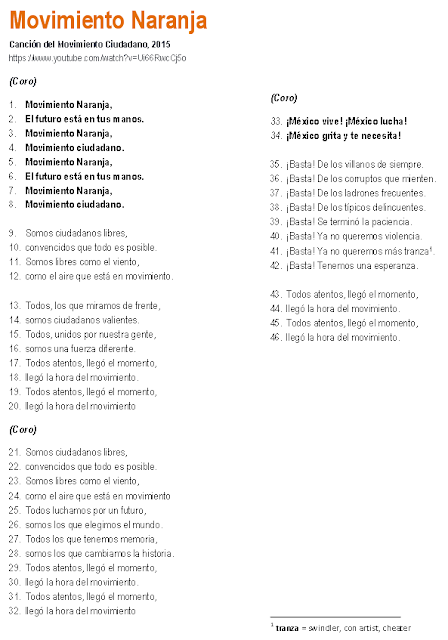
Here's a song that I heard on the radio* a few weeks ago. It was so catchy that I immediately looked it up. As it turns out, it is a promotional music video for a Mexican political party.
As a disclaimer: I am not promoting this political party or any of their campaigns. But I am congratulating them on writing a simple, catchy song with a feel-good music video that includes lots of beautiful images of Mexico. There are quite a few familiar shots for my students and I - the border fence, and scenes from our neighboring city across the border, Tijuana.
I've used this for some grammar practice in middle school, and played it for my younger students to wrap up our Mexico-focused lessons about Cinco de Mayo. (It's a good "get the classroom cleaned up" song, too.)
Thanks to the folks in the Spanish Teacher Share group on Edmodo for helping me find and correct the lyrics! Here they are, with several different activities I did with my students:
Cognates: Matching translations (to lines with lots of cognates)
Grammar/Conjugation: Ser, Estar, and Tener conjugations
Advanced: What does this song tell us about the party's political platform? (Led to some interesting discussion of political propaganda in middle school.)
If you find any errors in the lyrics, let me know! Also, I haven't been able to find the name of the artist who wrote the song - do you know?
*Side note: Since moving to San Diego, I've discovered a new hobby: Listening to Mexican political ads awkwardly translated into English, on the English stations broadcast from Tijuana.
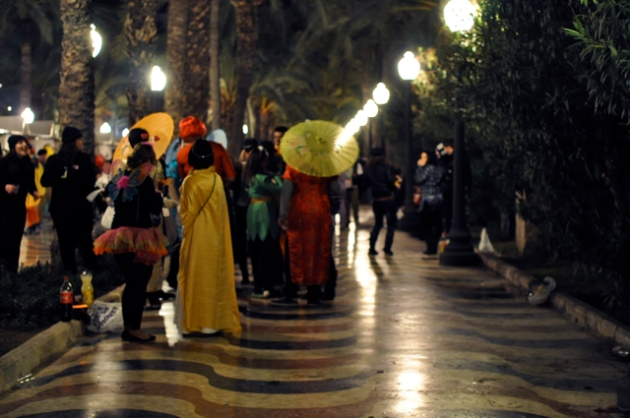
President's Day, the Lunar New Year, and Carnival were all jumbled together at the beginning of this week.
El Carnaval en Alicante, España.
My middle school classes have been working hard on other projects, so I wanted to create a somewhat independant exploration for students who were done with their projects, or for extra credit in some classes. Our schedule is a little messy right now after a 4 day weekend, so this was a fun "filler" to help get all the classes caught up.
Carnival/Carnaval/Mardis Gras is a truly multicultural topic of exploration, and there are so many great examples of colonized cultures combining (or disguising) their beliefs with newer Catholic traditions. It's also a good example of some traditions that are fun enough on their own, even without the complex historical background behind them!
This might be belated for this year, but I wanted to share some of the resources I used this year related to El Carnaval! Here is a leveled list separated by learning style, with resources in both English and Spanish.
I gave this list to my students directly, along with this paper. They could choose which resources they used to find the answers to the questions, according to their language level, learning style, and interests.
(I went paperless with some classes by creating a Google Form of these questions, too - I can share the template with you if you wish. Feel free to contact me!)
Do you have any more great resources related to Carnival? I am especially interested in expanding my knowledge of celebrations in Latin America - my only personal experience is from Spain and my own Catholic childhood.
Hello all! My posts have been a little sparse in the new year so far. I have been a little swamped with the end of the semester grades and report cards, but I'm introducing some things during the new semester and I'm hoping to share some of them!
In 3rd and 4th grade we have been beginning the class all year with a greeting song, but after a few months of that I think they are ready for something fresh and a little more involved. We are learning Paz y Libertad, by José-Luis Orozco.
This is from his album De Colores, which I love. I have both the book and the CD:
The book has the lyrics, music, and beautiful illustrations, but I wanted to make sure my students could understand the song they were singing. So I created a lyric sheets with some key words illustrated. (You can find the PDF here.)
I had my students see if they could read and understand the main ideas of the song, with the support of the pictures. We went through each verse individually, adding actions, and then sang the whole song together with music. It's simple and repetitive enough that the kids could sing along with the chorus almost immediately.
We also spoke about what peace and liberty mean, and real life examples of each (in a kid-sized context.) To wrap up the lesson I had kids illustrate one of the verses on the back of their paper. (Lots of people wanted to illustrate the last one.) I reminded them that they should illustrate what peace and liberty might look like in each of the situations mentioned in the song... so we didn't just produce pictures of bombs and kids fighting.
When we sing the song together, we'll use the lyrics sheets and illustrations as a listening activity - kids will listen for their verse and hold up their illustrations when we get to it.
Pie charts for all!
No más. Sí, mas.
For my kids, this was a successful (and meaningful) way to introduce a new song. I hope it can be useful to you, too!
This week we are back in school after two weeks off, and we have several new students in middle school. I put together this rompehielos (icebreaker) to help those kids get to know their classmates a little better, while reviewing and introducing some new vocabulary.
I focused on the verbs tener and gustar. We've used both verbs before, but haven't had a lot of practice fully conjugating them.
Here's the document as a PDF and as a Word document, if you would like to make some changes.
I did this with 7th and 8th grade, and it worked out well. It was a way to channel the just-back-from-break chatter into some authentic communication.
Briefly review the verbs. I gave students this cheat sheet on the back... including some corny memes.
Let students preview the vocabulary. For my more basic classes I starred some boxes I wanted them to start with (that used familiar vocabulary or cognates.)
Model how to ask for the necessary information. Many kids will try to just ask "¿Tiene un gato?" since that is how it is written on the paper, instead of using "tienes." (When I pointed this out one bilingual student theorized that they were just using the Usted form... so maybe they were just being super polite?)
Model how to negotiate meaning without translating. I showed examples of how to give hints without switching to English: If your partner doesn't understand the question, try pointing out the word on the paper, acting it out, etc.
Grab a paper and participate yourself. You will find out some things about your students, and can provide a model for students.
Ask follow up questions. It was fun to see which categories were the hardest to find. (¿Nadie tiene un hámster?)
Another quick, ready-to-use resource that would work with even basic level students. An accompanying worksheet I made is available here, including some names for Santa Claus in various Spanish-speaking countries: ¿Cómo se escribe mountain bike?
Before holiday break, I like to introduce students to a variety of holiday traditions in Spanish-speaking countries. My strongest lessons involve traditions from Spain, since I lived there (and Catalonia has some pretty fascinating traditions that can truly get the attention of middle school students...) It is impossible to discuss holiday traditions in Spain without a discussion of religion, and this is always a good opportunity to compare Spain (with an official state religion) and the United States (with a strict separation of church and state.)
As a language teacher I think it is important to look beyond just the cultures and religions that are in the majority, and this time of year is a unique opportunity to expose kids to some less commonly known traditions and even languages. Many of my December lessons involve Christmas traditions, but I always use the Hanukah song Ocho Kandelas to introduce my students to Ladino.
Even very young students can compare the lyrics in Ladino to Spanish that they already know (particularly the numbers) and the song is simple and catchy enough to sing along. We talk about the (abbreviated) historical relationship between Judaism and Christianity in Spain, and why so few people speak Ladino now. We discuss languages that are endangered or rare, language education and cultural identity, and beyond. I've had some pretty fascinating discussions with kids as young as first grade.
(Bonus: For some fantastic music from the Ladino tradition, check out Yasmine Levy. My father in law gave me a CD last year for Christmas, after I explained this lesson to him.)
Print & use today:
Comparison of the lyrics of Ocho Kandelas in Ladino, Spanish, and English
Ladino - easier reading in Spanish, ready to print with comprehension questions
I feel that I am always trying to sneak Spanish numbers into my curriculum. Numbers on their own are not very exciting, and I try to build my lessons on communicative (and hopefully engaging) objectives. If there is not an established and well articulated language curriculum, I often encounter students who are tired of going through several years of repetitive lessons: greetings, numbers, colors. The challenge is always finding interactive and quick ways to refine and review these skills, while still offering structure for the students who are starting with limited experience.
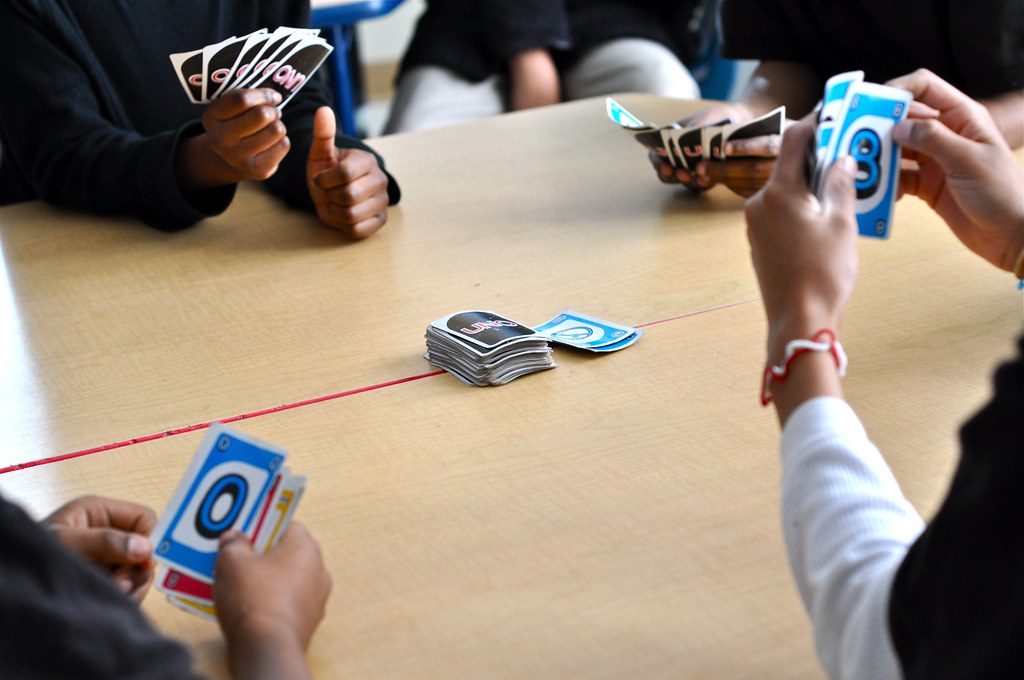
Uno was always my review card game of choice - until I discovered the magic and ease of ¡Pesca!
Out of everything I have tried over the years, here are a few resources and activities that have been successful to review and practice the numbers in Spanish. These are ready-to-go activities that you can use this week if you'd like... or today in the next class period, if you are quick on your feet. (You probably are, if you are a teacher.) These are things I have used successfully in classes with a wide range of levels and experience: from students fluent in Spanish to students who are in the first Spanish class of their life.
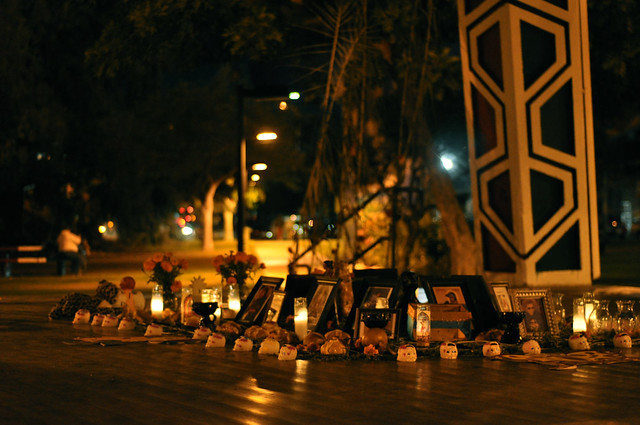
This is one of my favorite seasons with my students, and I have a feeling that this year I will be learning even more than I teach. As a newcomer to San Diego, I am excited to see some local celebrations, and to get input from my students who have celebrated this holiday with their families.
Here are some of the things I have done with my students in the past, and some things that will be included in my lesson plans for this week.
Let students explore some of the sights and sounds of the holiday.
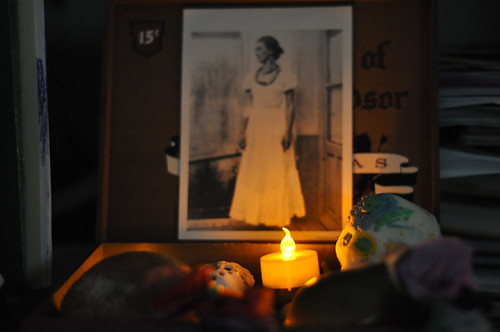
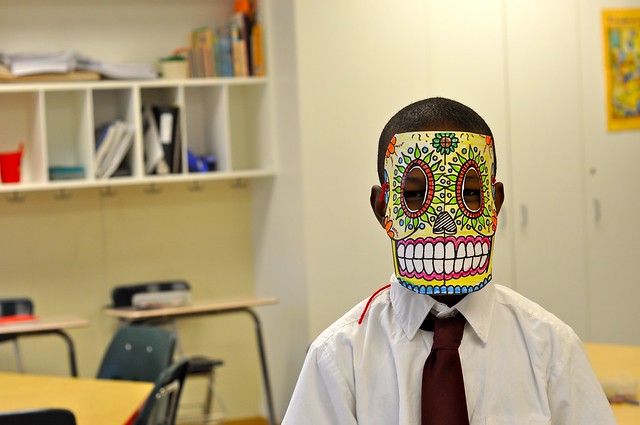
I love the opportunity to hook students with something mysterious. As a traveling elementary teacher, in past years I have put together a mini portable altar in a wooden cigar box, with a picture of Frida Kahlo (a favorite figure that most of my students learn about at some point in their time with me.) I light the "altar" with battery operated candles, and the flicker of yellow light from inside a closed box gets everyone's attention. Usually I extend the suspense and leave the box closed until we have explored some resources together, and then I will invite students to gather around and look at what is inside the box (photos, candles, flowers, sugar skulls... all things they just saw in a book or video.)


 book.)


 movie, which was released last year. I'll be leaving that with my sub plans. While researching resources for the film, I stumbled across a newly released song by La Santa Cecilia from nearby Los Angeles. I'm definitely going to use this to introduce the holiday and set the stage for when I'm gone.


 . My father in law gave me a CD last year for Christmas, after I explained this lesson to him.)