Showing posts with label songs. Show all posts

Friday, December 30, 2016

Soy Yo

At this year's most recent middle school dance, I asked the DJ to play this song. When it came on, the kids screamed and started flailing around. (As much or even more so than for the previous Whip/Nae Nae, if I might say with a fair amount of pride.) Seeing the kids dance and sing along in Spanish was one of my high points as a middle school teacher. 


Here are some resources I have used with this song:
  • Reading Activity (adapted from this article about Sarai, the girl in the video)
  • Lyrics Training activity using Soy Yo (to sing karaoke or do a listening activity)
  • Lyrics activity from Zachary Jones from his ebook, Cancionero 2015 - I use many of his activities (both free and purchased) and any of his ebooks have been well worth the money.
  • Speaking of Zachary Jones, he has a great series of interviews called ¿Cómo eres? None with little Sarai yet, but one can hope. I used these as a somewhat independent listening activity and students liked them so much that I added it as an option to our monthly homework options.
  • Another related song was Como soy by Manu Manzo, who does have a ¿Cómo eres? interview.
7th grade in particular has been a little obsessed with this song (I've caught kids singing it in the halls, and heard rumors that kids brought it up during some recent restorative circles in morning meetings.) I'm using some of that energy to kick off our 2nd trimester project about language & identity, connected with a skills unit on descriptions. More to come on that, hopefully.

Related resources bumping around in my files:
  • Eres by Café Tacvba is another song I've used to introduce or review the conjugation of ser. Not quite as catchy as this one, but the kids still mention "that creepy black and white song.") 
  • A few years ago (in my first dabblings in PBL) I had students find a song of their choice and use the lyrics to search for targeted grammatical structures. Here's my first attempt at that mini-project, which I may revisit.
Big Picture: Grammar & music

I'm still struggling to balance PBL and proficiency, especially when it comes to grammar & conjugation, but using music is one thing that has been consistent through my evolution as a teacher. Songs were what kept our heads above water during my early years of treading water in Detroit, as I gathered a collection of songs that drove my K-2 curriculum and used music (including the only alphabet song I can stomach) to engage some of my most challenging middle school classes. As I learn more about project based learning and how to let students learn by doing, music has been a great resource for experiencing verbs in their natural habitat. If a song is catchy enough the grammar structures will stick in students' heads, and if it is repetitive enough it can allow for some "DIY" grammar rules based on observations of repeated patterns in a song.

Finally, anything that makes students spontaneously yell things in Spanish I'll count as a success in the complicated, often-grumpy land of middle school language teaching.

Saturday, November 28, 2015

Crossover vs. Computer (Spanish Teacher vs. Online Translators)

At my school middle school students have Google accounts through the school, and access to chromebooks. Although I consider myself to be pretty tech savvy, this is the first time I've been at a Google school and the first time my students have really had reliable access to technology. Overall that's a huge benefit - there are so many amazing digital tools available for both teachers and students. However, learning to use them productively and responsibly has been a learning curve for all of us. As a language teacher, I've had to balance the benefits of these digital tools with the strong temptation of one tool in particular - Google Translate. When beginning students hit the wall of their language limitations, it's easier to take the easy way out. Last year I dealt with many individual cases of students using online translators, and I realized I needed to be more proactive this year.

This year I made sure I included a note about online translators on my syllabus, and explained that for language learners this is a form of academic dishonesty.


However, I wanted to go deeper than that. Beginning language learners turn to easy shortcuts like Google Translate because it's quick, but because it seems like a viable solution when they can't produce the language they want. To all appearances the computer knows more language than they do. However, even a beginning learner will make different errors than a computer. I wanted to show students the awkwardness of computer translation, and why it's pretty easy to spot.

To do this, I found songs that had been released in English and in Spanish - Perdón by Enrique Iglesias & Nicky Jam and Tengo tu Love by Sie7e. (Links are to PDFs that I used.)I gave students a side by side comparison of some of the verses: the Spanish version, the English version, and a Google translation of the Spanish into English.

I asked students to examine each set of lyrics and think about which lines were translated awkwardly by Google Translate, and what changes the artist made so the lyrics worked better in a new language (or new culture.) Songs are a great way to highlight why exact translation sounds clunky. "Ricky Martin's got the looks" is catchier than the literal "Ricky has cute face," and sometimes crossover artists leave some simple lines untranslated - because eso no me gusta, eso no me gusta just sounds better!

The students had fun with this activity and it was a great way to talk about translation with them. As they were working on their pen pal letters over the following days, I overheard several encouraging comments.

"No, don't use Google Translate! Dude, we just did a whole activity about this!"

Any other fun examples of awkward translations? Here's an interesting news article about a Spanish town's reliance on Google Translate that got very awkward (though I'm not quite ready to go into that vocabulary realm with my middle school students.)

Side note: I had the chance last week to go to ACTFL here in San Diego, which was great.. but even after a whole week of break I haven't managed to finish processing the massive amount of ideas, notes, questions, resources and professional connections from the conference. More on that later!

Sunday, May 24, 2015

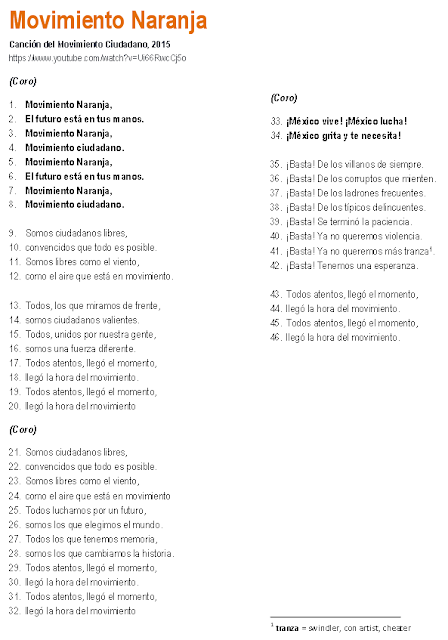
Movimiento Naranja - Movimiento Ciudadano

I haven't posted much here recently. I've been busy with some exciting things (working to expand the Spanish program at our school, lots of cross-curricular planning for next year, and some end-of-the-year projects with the middle school students.)

Every year at the end of the year, I find myself trying to do things that are too complex and too long for the inevitable chaos of end-of-the-year schedules, where student and teachers alike are affected by state testing, field trips, camps, absences, and (in my case recently!) immune systems that are succumbing to end-of-the-semester stress. I'm excited about some of the projects my middle school students are doing - but a little hesitant to share before I see how they turn out.

However, I want to use this blog to reflect on what I'm doing, and to share what is working - so I'm attempting to do that, even in these last crazy weeks of the school year! Here's something that may be useful to you as the school year winds down.

Here's a song that I heard on the radio* a few weeks ago. It was so catchy that I immediately looked it up. As it turns out, it is a promotional music video for a Mexican political party.


As a disclaimer: I am not promoting this political party or any of their campaigns. But I am congratulating them on writing a simple, catchy song with a feel-good music video that includes lots of beautiful images of Mexico. There are quite a few familiar shots for my students and I - the border fence, and scenes from our neighboring city across the border, Tijuana.

I've used this for some grammar practice in middle school, and played it for my younger students to wrap up our Mexico-focused lessons about Cinco de Mayo. (It's a good "get the classroom cleaned up" song, too.)

Thanks to the folks in the Spanish Teacher Share group on Edmodo for helping me find and correct the lyrics! Here they are, with several different activities I did with my students:
  • Cognates: Matching translations (to lines with lots of cognates)
  • Grammar/Conjugation: Ser, Estar, and Tener conjugations
  • Advanced: What does this song tell us about the party's political platform? (Led to some interesting discussion of political propaganda in middle school.)
If you find any errors in the lyrics, let me know!  Also, I haven't been able to find the name of the artist who wrote the song - do you know?


https://www.dropbox.com/s/12dcw0be2l1xvbx/Movimiento%20Naranja.docx?dl=0


*Side note: Since moving to San Diego, I've discovered a new hobby: Listening to Mexican political ads awkwardly translated into English, on the English stations broadcast from Tijuana.

Sunday, February 1, 2015

Paz y Libertad

Hello all! My posts have been a little sparse in the new year so far. I have been a little swamped with the end of the semester grades and report cards, but I'm introducing some things during the new semester and I'm hoping to share some of them!

In 3rd and 4th grade we have been beginning the class all year with a greeting song, but after a few months of that I think they are ready for something fresh and a little more involved. We are learning Paz y Libertad, by José-Luis Orozco.

This is from his album De Colores, which I love. I have both the book and the CD:


The book has the lyrics, music, and beautiful illustrations, but I wanted to make sure my students could understand the song they were singing. So I created a lyric sheets with some key words illustrated. (You can find the PDF here.)


I had my students see if they could read and understand the main ideas of the song, with the support of the pictures. We went through each verse individually, adding actions, and then sang the whole song together with music. It's simple and repetitive enough that the kids could sing along with the chorus almost immediately.

We also spoke about what peace and liberty mean, and real life examples of each (in a kid-sized context.) To wrap up the lesson I had kids illustrate one of the verses on the back of their paper. (Lots of people wanted to illustrate the last one.) I reminded them that they should illustrate what peace and liberty might look like in each of the situations mentioned in the song... so we didn't just produce pictures of bombs and kids fighting.

When we sing the song together, we'll use the lyrics sheets and illustrations as a listening activity - kids will listen for their verse and hold up their illustrations when we get to it.

Pie charts for all!

No más. Sí, mas.
For my kids, this was a successful (and meaningful) way to introduce a new song. I hope it can be useful to you, too!