Monday, November 9, 2015

Tarea Mensual: What middle school homework looks like this year

The short version of this post:

Here's a copy of my monthly homework options for middle school Spanish students! Tarea Mensual: Differentiated Spanish Homework Options (It's my first resource posted on Teachers Pay Teachers, and it's free!)

And for those of you who want to hear about how and why I put together this resource...

I spent a lot of time over the summer thinking about homework in middle school Spanish. (I rambled a bit about this over here.) At EdCamp this year I had the chance to hash(tag) this out at a great discussion with Alice Keeler. I don't feel as a language teacher I can give up on homework if I really want kids to be proficient - class time just isn't sufficient for learning a language. However, I do need to make sure homework is manageable and meaningful.

As a teacher, "dream homework" would do all of the following:

  • Homework should get kids to use Spanish outside the classroom - including reading, writing, listening, and reading, at appropriate levels. (That's the tricky part!)
  • Homework needs to be accessible for all my levels of students - from beginners to native speakers.
  • Homework needs to be engaging, relevant, and enjoyable (so that kids wantto do it.)
  • Homework shouldn't rely on internet access. We are using Google Classroom this year, which makes assignments so much simpler from my point of view - and for most of my students. However, not all my students have internet access. 
  • Homework shouldn't make or break a grade. Kids have wildly varying home situations and access to support. It's not fair for me to rest an entire grade on something I can't help students with.
  • Homework should not take over anyone's life. This applies to both students and teachers! Even in middle school, homework can start to take over - especially for the students who care about their grades and care about completing their homework, who in many cases are also the ones involved in extracurricular activities. I also can't let homework take over mylife - I have so many students, and I want to spend my time planning and assessing projects, not homework!
With all this in mind, and inspired by the homework choices over at Musicuentos,I started the year with weekly homework options to choose from. Students were to choose one or a combination of activities from a list, and turn in a report at the end of the week via Google Classroom. Those first two weeks were a little chaotic. Remember how homework shouldn't take over anyone's life? Homework took over my life. Students were confused about the report format (a normal learning curve, perhaps) and most of them just emailed me screenshots or questions, swamping my email inbox with emails. With the option of choosing a variety of 1 pt, 3 pt, and 5 pt activities, students all wanted to do the harder 5 point activities for more points - though these were often too hard for them. (Lead Us Not Into Google Translate Temptation.) I made some necessary adjustments that I think were important. 
  • Students get a grade based on whether they complete a variety of activities and submit proof. Activities are not assigned individual point values. I don't assign point values to any particular activity (since kids were tempted to go for the more "valuable" activities, when often these were not appropriate for their level.)
  • Students turn in one report at the end of the month, describing what activities they did that month. Weekly reports were just too much, for me and my students. Students need 4 activities for the month, but they can complete those at their leisure.
  • Students have some class time near the end of the month to complete the reports via Google Classroom. This makes the assignments more accessible to students who lack computer access at home, or who are less tech savvy... or who just aren't going to remember to turn in their report on their own.

So far I've gotten positive feedback from students. They've enjoyed picking activities themselves, and some have found resources they really enjoy. (Lyrics Training and Free Rice are some favorites.) So far I've rolled out this homework with 7th and 8th graders (3 classes in all) and I have found it fairly manageable as far as grading goes - using Goobric and Doctopus* for my workflow, I've been able to grade the homework for one class in 45 minutes (including individual comments.) That's not too bad for monthly homework!

We'll see how this evolves! I'd love any feedback and suggestions if you've done something similar with your students, or if you find this useful for yourself!

*Please do let me know if you'd like to know more about how I've streamlined my grading process with these tools!

Tuesday, October 27, 2015

Día de los Muertos - Resources you can use tomorrow

I'm finishing up some sub plans for upcoming absences, and let's be honest - this is the time of year where many teachers need some sub plans even if they aren't going to be absent. By that I mean: you're so swamped by parent emails, test administration, professional learning, and preparing for parent conferences that planning time is limited. (Also, Halloween is coming up this weekend, so kids are going to be a little distracted.)

I feel fortunate because as a Spanish teacher, I can use this time of year for some cultural lessons connected to Day of the Dead - something that's meaningful and engaging, even for burned out teachers and sugared up students.

I figured I'd reshare one of my favorite and most versatile Día de los Muertos resources - this brief digital short that's touching, really encompasses a lot of traditions, and is engaging for all ages. (I've used it successfully from everyone K-8.)


Some things you can do with this video:
  1. Focus on listening and reading! Learn more about Movie Talk here (including a demo by Martina Bex.) See some slides with stills that I put together to talk through the story (it was just clearer than pausing the video for me.) I also use a written text with vocabulary questions at the end. (I started with Dustin Williamson's as an example, but changed it to present tense and edited it to make it fit with my students' needs.) 
  2. Cultural focus: Show the video as an intro to the traditions involved in Día de los Muertos and have students compare and contrast it with traditions in their own families. Here is a packet of information I've used.
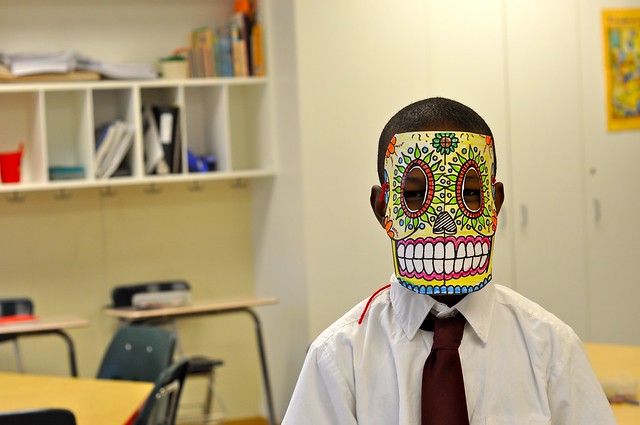
  3. Follow up: Depending on how much time you want to spend and the grade level of your students, follow up with one of these resources or a simple calavera mask using one of HappyThought's free templates or the one from AZ Central's teacher packet.

¡Buena suerte!

Día de los Muertos
A mask using AZ Central's template.

Sunday, October 25, 2015

Calaverita - La Santa Cecilia

It's that time of year again!

Untitled
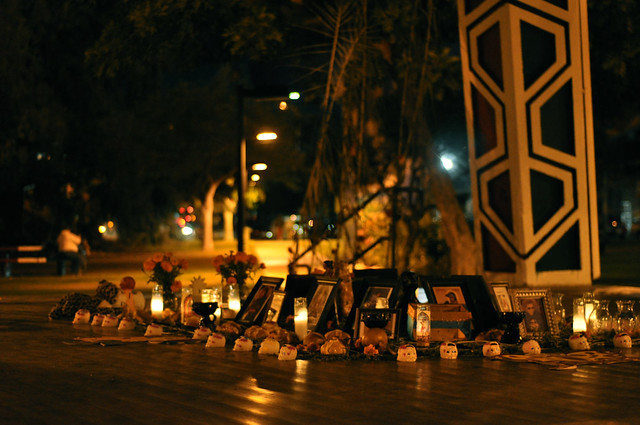
Chicano Park - Día de los Muertos, 2014

I have some absences coming up due to training, jury duty, and out of town weddings, and so I'm trying to come up with sub plans that are engaging. Luckily, it's Day of the Dead season, and there are lots of resources out there! Last year I shared some of the resources I've used, and a list that I've added to since then.

I just bought the Book of Life movie, which was released last year. I'll be leaving that with my sub plans. While researching resources for the film, I stumbled across a newly released song by La Santa Cecilia from nearby Los Angeles. I'm definitely going to use this to introduce the holiday and set the stage for when I'm gone.

I love so many things about this video. It includes many traditional Día de los Muertos symbols, as well as some not-so-subtle references to current events (did you catch Zombie Trump?) Most importantly, it conveys the spirit of the holiday and the underlying attitudes toward death.

It was Kara Jacobs who pointed me to this song and compiled several great resources. I will be using a revised version of the lyrics she posted, with questions that fit with my diverse student levels.

If you'd like a copy: Google doc here, or as a PDF here.

Saturday, September 19, 2015

¡Hola hola, Coca Cola!

I just survived the second week of school, and am recovering with a Saturday morning cup of coffee. I've never felt so unprepared for the school year - even two weeks in! Luckily the first weeks of the school year are a chance to incorporate simple class routines that don't necessarily rely on all the little details being in place. (Like supplies... keys to classrooms... access to printers... access to technology... access to curriculum...)

Calling the attention of the class is one of those tiny things that makes a big difference in classroom management. In the past I've tried several things:

  1. Counting down in Spanish.
  2. Patterns of claps or snaps.
  3. "¿Clase?" and "¿Sí?"
  4. A rain stick (which was fun, but quickly fell by the wayside when I became a traveling teacher again!)
Training kids to recognize these and being consistent is probably the most important part of any quiet signal, but I'm always trying to find ways to incorporate authentic language and culture into classroom routines. Halfway through last year I found this fun list of rhymes and started using those with my younger classes. They were so much fun that this year I'm using these as my attention signals with everyone. Here is the list I use, and some bigger signs that I use as cues. (They just have the first part of the rhyme and a picture, as a cue for the response.)

I love these because they are more authentic and interesting than my other methods. (My native speakers can repeat many of them the first day.) Also, I've found that "quiet signals" are universally more interesting if there is some intrinsic motivation to stay quiet - for example, waiting to see what the next rhyme may be!

Do you have any rhymes to add to this list?


Sunday, August 30, 2015

Middle school Spanish grades: Big picture musings and small scale plans

It's August! Not only that... it's the end of August! Teacher week starts tomorrow. I meant to post more during the summer. I have been doing a lot of planning and reflection this summer, but none of that translated into blogging. We've also been moving into our brand new building, which is very exciting (and very time-consuming!)

I've been meeting with the middle school team this summer to plan for the year. We have several new teachers on the team, a brand new building, and a lot of new changes to plan for. We've been talking about grades, and I've been trying to figure out how to align our school-wide policies with my Spanish class policies.

My big-picture grading philosophy can be narrowed down to the following:

Grades should show students, teachers, and parents what students have learned and what they need help on.


That's it! Despite our educational system today which is very focused on numbers and scores, I don't believe students should be narrowed down to static numbers. My teaching shouldn't be narrowed down to numbers. And yet so much of my time is spent on numbers. During those marathons of final grades, I lose myself as a teacher and even as a human, and become GradeBot - typing numbers into little boxes. I want to make sure those numbers are at least meaningful.

GradeBot is usually fueled by coffee. So much coffee.
Here are a few of the big-picture grading questions I've been asking myself:

  • How can I make sure my grades allow for and show growth across all language levels in my classes? My classes include a wide range of students - bilingual students who are also biliterate, native speakers with little exposure to the written word, students from immersion schools, students who I had last year, students who are brand new to Spanish, students who are pulled from half or all of my classes due to IEPs, and everything in between. I want my students to grow from wherever they are at, and I want my grades to reflect that. 
  • How can I make sure my grades reflect what students know and can do in Spanish, not just completion and effort? Participation, effort, and work completion are all very important in language learning. I think it's important that students are rewarded for hard work. However, when students earn points based just on whether they've attempted, it doesn't give anyone (teachers, students, or parents) a very clear idea of exactly what skills they have mastered. Last year I was doing a lot of research and thinking about Standards Based Grading. I think it's important for grades to show what students can do in Spanish, and SBG seems like a logical way to do that. I also would love to see a shift away from letter grades and percentages to grades that show how well students have mastered specific objectives. (Our elementary grades use the Common Core 1-4 grading scale, for instance.) However, as a team we aren't quite ready to make that jump, at least not this year among all the other big-picture changes that are happening. So in middle school, we'll be using a more traditional point system again.
  • How do I make sure assignments are meaningful and not just empty points? Homework in particular is tricky in this sense. I want students to practice outside the classroom, but it's hard to regulate that. If homework or classwork is not meaningful, only the students motivated by those points will do it - and might not be learning much from it anyway.
  • How can I make sure grades are easily understand by both students and parents? At the end of last school year a disappointed parent was unhappy that her daughter did not get perfect grades in Spanish. She commented that she thought I must be giving the good grades to "all the Hispanic kids." I'm trying to use my gut-punch feeling as impetus - I want to have a very clear vision and justification for my grading system, that I can share with parents and students. (In reality, as a general group my native speakers had a wildly varying range of grades.)
  • How do I best use my grading time? I'll be teaching eleven different classes this year, across grades 3 through 8. We've increased Spanish time in all grades - which is wonderful! - but that means that my schedule is pretty packed. I need to use my grading time wisely. I don't need to grade every single thing my students do. How do I plan out exactly what I will be grading in a smart way that lets us all (teacher, parents, students) know what students can do?
  • How do I teach from a textbook in a meaningful way? This is a little bigger than just a grading question. This year is the first year I will be teaching with a textbook in middle school. We just got Avancemos (Level 1) for middle schoolers. I'm excited about the structure and resources it offers - after seven years of making everything from scratch, from curriculum maps to daily lessons to assessments, K-12! However, I want to use the textbook as a tool, not as a crutch.

As I've been pondering these things, I've had some great insight from other language teachers:


So how is this going to play out this year?

In middle school, we've agreed on three weighted grade categories:

  • Homework/Classwork (30%)
  • Assessments (20%)
  • Projects (50%)

For me, this is what that will look like in my middle school grade book:

  • Homework/Classwork: Participation is so important in a language class - and a tricky thing to keep track of! This year I'm trying to focus my participation grades in two ways:
  • Assessments: I like that Avancemos has a variety of differentiated assessments for their units. I'm not sure how many of these I'll actually have - I'm still waiting on the curriculum materials. I like that this is only 20% of the grade - I prefer to see what students can do through projects, but it's nice to be able to hone in on specific skills too. This is a good category for students and parents to see a breakdown of specific skills.
  • Projects:We are a project based school, though this is definitely an area of growth, especially in middle school. We are still trying to figure out how to create meaningful cross-curricular projects, and I think we'll be spending a lot of our professional development time on this. (We have half days every Wednesday to leave PD time in the afternoon.) I have ideas that I'm excited about, but I'm not sure how much planning time I'll get with other teachers this year. Within middle school Spanish classes, however, I will have a variety of projects. Because this is 50% of their grade, a lot of things will fit under this umbrella:
    • Planning activities
    • Project check ins (to check student progress throughout the project)
    • Final project grades (with a rubric connecting the project to our objectives)
    • Presentations
    • Reflections
Now... how to put this into a syllabus in a condensed way...

Tuesday, June 9, 2015

Chicano Park

Untitled
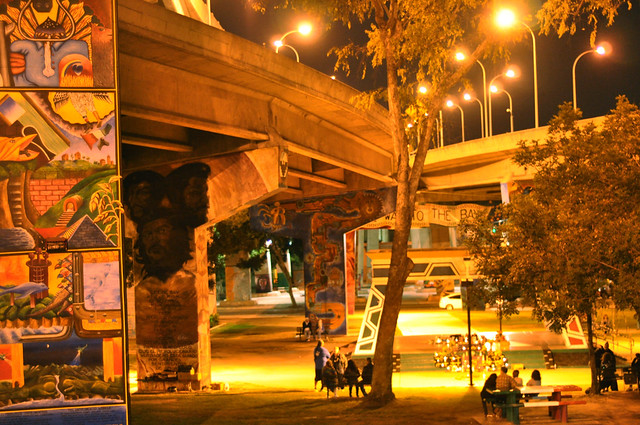
Chicano Park - Día de los Muertos, 2014 (My first visit to the park.)
Earlier this month I had the chance to go with the 6th graders to Chicano Park here in San Diego. The field trip was part of a really cool cross-curricular Social Justice project that they were doing in their other classes. Next year I want to integrate a lot more connections in my Spanish class, but I was really excited to go along this year, and I want this to be an ongoing part of my Spanish curriculum.

Back in Detroit, I collaborated with the art programs at both schools I worked at, to take field trips to the Detroit Institute of Art, especially to see Diego Rivera's mural. It's an amazing mural with significant ties to local history and culture, and I was sad to leave it behind when I moved to California.

Since I moved to San Diego in August, I've been looking for local opportunities. Chicano Park has an amazing history and is the perfect place for students to learn about art, the local Spanish-speaking community, our identity as a border town, alternative histories, and an inspiring example of grassroots movement and personal activism that they are studying through their Social Justice project.


We got a great tour by members of the park's steering committee. My group was led by Victor Ochoa, one of the muralists. I learned as much as the kids did!

Before going on the field trip, I made this scavenger hunt for the kids. They looked for the phrases around the park and matched them to the murals they were included on, and then later in Spanish class we translated them and connected each phrase to the history we had learned about. (The file includes an answer key. I made it using images from this documentation project, but I already know I'll be updating it with more images and phrases later on.)

https://www.dropbox.com/s/h8ejmkpztb8hrdu/Chicano%20Park%20Phrase%20Scavenger%20Hunt.docx?dl=0

As a follow-up project, students are researching and presenting information about people from the Spanish-speaking world. This includes famous Hispanic figures, some relatives and family members, and people they learned about during the field trip. I used one of the murals from Chicano Park as a starting point for this project, and created a Thinglink for students to explore the people and symbols pictured.


This year, the field trip, subsequent project, and curricular connections were all somewhat hasty, in the midst of end-of-the-year chaos and the general upheaval of establishing and refining a new program at a new school. I have high hopes for next year, however, and am excited to do more.

The Chicano Park Steering Committee was so helpful in coordinating and leading our tours. They have a website at www.chicano-park.com.

For local educators - if you have led field trips to Chicano Park or would like to in the future, I would love to hear more about what you have done, share resources, and collaborate!

Untitled
Chicano Park - Día de los Muertos, 2014

Sunday, May 24, 2015

Movimiento Naranja - Movimiento Ciudadano

I haven't posted much here recently. I've been busy with some exciting things (working to expand the Spanish program at our school, lots of cross-curricular planning for next year, and some end-of-the-year projects with the middle school students.)

Every year at the end of the year, I find myself trying to do things that are too complex and too long for the inevitable chaos of end-of-the-year schedules, where student and teachers alike are affected by state testing, field trips, camps, absences, and (in my case recently!) immune systems that are succumbing to end-of-the-semester stress. I'm excited about some of the projects my middle school students are doing - but a little hesitant to share before I see how they turn out.

However, I want to use this blog to reflect on what I'm doing, and to share what is working - so I'm attempting to do that, even in these last crazy weeks of the school year! Here's something that may be useful to you as the school year winds down.

Here's a song that I heard on the radio* a few weeks ago. It was so catchy that I immediately looked it up. As it turns out, it is a promotional music video for a Mexican political party.


As a disclaimer: I am not promoting this political party or any of their campaigns. But I am congratulating them on writing a simple, catchy song with a feel-good music video that includes lots of beautiful images of Mexico. There are quite a few familiar shots for my students and I - the border fence, and scenes from our neighboring city across the border, Tijuana.

I've used this for some grammar practice in middle school, and played it for my younger students to wrap up our Mexico-focused lessons about Cinco de Mayo. (It's a good "get the classroom cleaned up" song, too.)

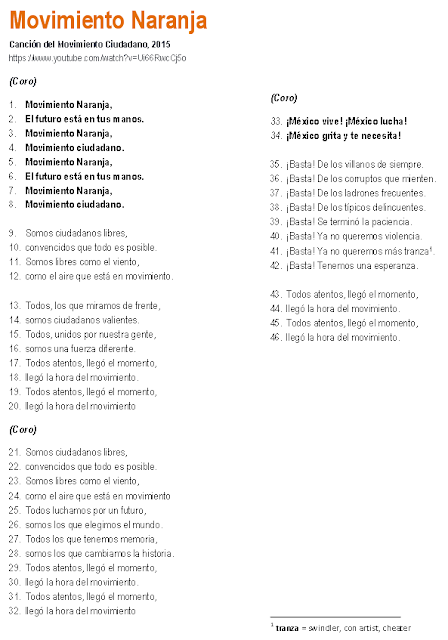
Thanks to the folks in the Spanish Teacher Share group on Edmodo for helping me find and correct the lyrics! Here they are, with several different activities I did with my students:
  • Cognates: Matching translations (to lines with lots of cognates)
  • Grammar/Conjugation: Ser, Estar, and Tener conjugations
  • Advanced: What does this song tell us about the party's political platform? (Led to some interesting discussion of political propaganda in middle school.)
If you find any errors in the lyrics, let me know!  Also, I haven't been able to find the name of the artist who wrote the song - do you know?


https://www.dropbox.com/s/12dcw0be2l1xvbx/Movimiento%20Naranja.docx?dl=0


*Side note: Since moving to San Diego, I've discovered a new hobby: Listening to Mexican political ads awkwardly translated into English, on the English stations broadcast from Tijuana.