Another quick, ready-to-use resource that would work with even basic level students. An accompanying worksheet I made is available here, including some names for Santa Claus in various Spanish-speaking countries: ¿Cómo se escribe mountain bike?
Before holiday break, I like to introduce students to a variety of holiday traditions in Spanish-speaking countries. My strongest lessons involve traditions from Spain, since I lived there (and Catalonia has some pretty fascinating traditions that can truly get the attention of middle school students...) It is impossible to discuss holiday traditions in Spain without a discussion of religion, and this is always a good opportunity to compare Spain (with an official state religion) and the United States (with a strict separation of church and state.)
As a language teacher I think it is important to look beyond just the cultures and religions that are in the majority, and this time of year is a unique opportunity to expose kids to some less commonly known traditions and even languages. Many of my December lessons involve Christmas traditions, but I always use the Hanukah song Ocho Kandelas to introduce my students to Ladino.
Even very young students can compare the lyrics in Ladino to Spanish that they already know (particularly the numbers) and the song is simple and catchy enough to sing along. We talk about the (abbreviated) historical relationship between Judaism and Christianity in Spain, and why so few people speak Ladino now. We discuss languages that are endangered or rare, language education and cultural identity, and beyond. I've had some pretty fascinating discussions with kids as young as first grade.
(Bonus: For some fantastic music from the Ladino tradition, check out Yasmine Levy. My father in law gave me a CD last year for Christmas, after I explained this lesson to him.)
Print & use today:
Comparison of the lyrics of Ocho Kandelas in Ladino, Spanish, and English
Ladino - easier reading in Spanish, ready to print with comprehension questions
After escaping the clutches of Michigan winters, such a balmy and sunny December here in San Diego has been a dream. Yesterday's rain, however, was pretty exciting... especially as a traveling teacher on an outdoor campus! Most of my materials escaped unharmed.
On the last day before Thanksgiving break, the 7th graders had dance performances during their morning P.E. class. Our P.E. teacher had students work in groups of 3 or 4 to research a specific style of dance, choose a song, prepare a dance, and practice it to perform. I got to watch a few of these, and it seems like an amazing project.
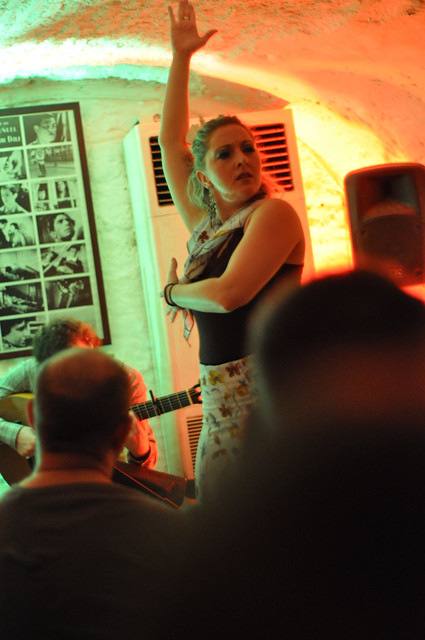
Three girls researched and performed a flamenco dance. I really wanted to see it, but I was teaching 5th grade and just barely missed the girls' performance, and caught them as they were clicking and swishing to their next class (in very clicky heels and very swishy skirts.) They offered to perform for Spanish class that afternoon, which seemed like a great way to spend the last hour before break. (Not always a time for strenuous academic effort.)
I am envisioning future Spanish-P.E. collaborations on this type of a project, especially for native speakers who could write reports in Spanish, and offer demonstrations that are kinesthetic enough for even more basic levels to understand.
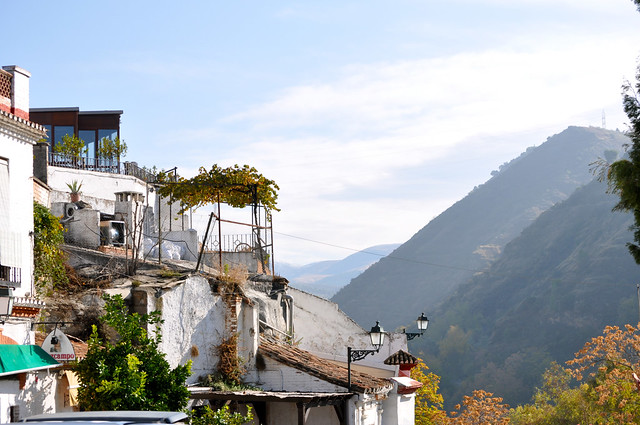
Sacromonte, Granada, where many caves in the hillside hold homes, shops, and famous flamenco performances.
I've used flamenco as a quick cultural lesson before, so it was a good thing to throw together at the last minute. The girls performed their dance, and explained what they knew about the history of flamenco. (They had to write a paper about the dance as part of the project, and as a result were able to teach me a few things!) We talked about the roles in traditional flamenco, the dialect in Andalucía (cantador vs. cantaor) and the cajón, which is also the name of a main road in San Diego and of a city nearby.
I showed them one of my favorite videos - Tengo, by Macaco. They compared (using these guided notes) what they knew about traditional flamenco with this modern video.
Other Flamenco resources:
Notes:
Flamenco en España - A presentation with with some images and examples of the elements of traditional flamenco. (All slides were created using images found via google search, so these images do not belong to me.)
Videos:
Flamenco en una cueva - A performance in one of the caves in Granada, which many consider the birthplace of the dance.
Flamenco en la calle - Street performers in Granada. This includes the use of el cajón, and a surprise halfway through.
Albanico mágico - A performance in San Francisco. This is a larger-scale interpretation of flamenco, using fans. (The video is 6 minutes long, so I usually let kids watch it if they are working on their own fans.)
Bailando - Enrique's popular song includes lots of dance styles, including flamenco.
Crafts: Los Albanicos
Depending how much time I am filling with this lesson (and whether or not the classroom is unbearably warm at the time) I have also used flamenco as a connection to the tradition of fans, in the dance and in Spanish culture. For teenagers, this is a chance to learn about the use of fans as communication in the pre-twitter, pre-texting era. For young students, this is a chance to practice the fine motor skills needed to fold fans. (They will need more help than you think.) For everyone, it's an excuse to fold paper fans and have a dance party.
This is a good end-of-the-day, end-of-the-week activity, since it generally leads to kids of all ages wiggling their eyebrows at each other over paper fans for the rest of the day. (And on more than one occasion I've had to save teachers' stacks of homework and worksheets from becoming fans, once young students get the hang of folding.)
I've heard of a lot of good ideas for creative vocabulary activities recently, at Edcamp and on Edmodo. (Using selfies to illustrate emotions, for example.)
My middle school students are working with descriptive adjectives right now, and I had them select a few of the adjectives and illustrate them. Many of my more artistically inclined students chose to draw the images themselves, but they could also find photos and images online or cut them from magazines and newspapers. This was a required assignment for 6th grade, and an optional extension activity for 7th and 8th, who were finishing up another project.
(One very artistic student illustrated the adjectives using all Harry Potter characters.)
Students who submitted digital illustrations were able to present them to the class, and those who turned in hard copies of their illustrations used them to create a pretty fabulous word wall in the classroom.
I have used student examples during bell work to practice recognizing
the adjectives, which has been more engaging than just using my own
examples.
I'm curious to see the results of this week's vocabulary quiz, especially the for the students who didn't do so well on our last assessment but who really got into the illustrations. I think that students' enjoyment of any activity is a pretty good indicator of its success... or at least how likely students are to do it in a timely manner. (Assignments that are fun to grade are also more likely to be graded in a timely manner.)
I'll definitely be using similar assignments in the future. Any other ideas for creative vocabulary assignments?
I've been trying to use music a lot more in my classes, especially with middle school. I've been structuring lessons, reviews, and assignments around music, as well as incorporating it into classroom management.
I was inspired by one of my coworkers, who is using music cues for math class. She uses popular theme music from television shows, played through this app. The app is nice because its designed for the classroom. (It doesn't automatically play the next song on a playlist, and you can set a specific time for the cue to begin.)
Here are the musical cues I've been using in my middle school classes, including links to the songs and the specific clips: Musical Cue Playlist. Most of these are from songs that students turned in as part of a project this past quarter, which helps with student buy-in.
La Vida es un carnaval - Celia Cruz
Transition to groups. (20 seconds.)
Te extraño - Xtreme.
End of class: Write down homework, get ready to be dismissed. (51 seconds.)
La Tortura - Shakira.
Get out homework, staple as needed, turn in to the correct folder. (1 minute, 22 seconds.)
Pa' Bailar - Bajofondo y Julieta Venegas.
Shut down computers and put away laptops according to our class procedure. (3 minutes, 36 seconds.)
Most of the lyrics are pretty carefully chosen, mostly because I think I'm hilarious. (Por supuesto, la tortura es la tarea... y no de excusas vivo yo.)
On that note, if anyone can rewrite La Totura to specifically be about lost homework, they will be my personal hero. (Fue una tortura.... perderte.) If I can get one of my students to take this on as a project, I will consider the year a success.
Technical tips:
I use Youtube and Dirpy to create clips from specific bits of the songs, but there are plenty of other similar tools out there, for all platforms. If you do use Dirpy, make sure you use the correct buttons. It is a free and ad-supported site, so it's easy to accidentally click ads.
I feel that I am always trying to sneak Spanish numbers into my curriculum. Numbers on their own are not very exciting, and I try to build my lessons on communicative (and hopefully engaging) objectives. If there is not an established and well articulated language curriculum, I often encounter students who are tired of going through several years of repetitive lessons: greetings, numbers, colors. The challenge is always finding interactive and quick ways to refine and review these skills, while still offering structure for the students who are starting with limited experience.
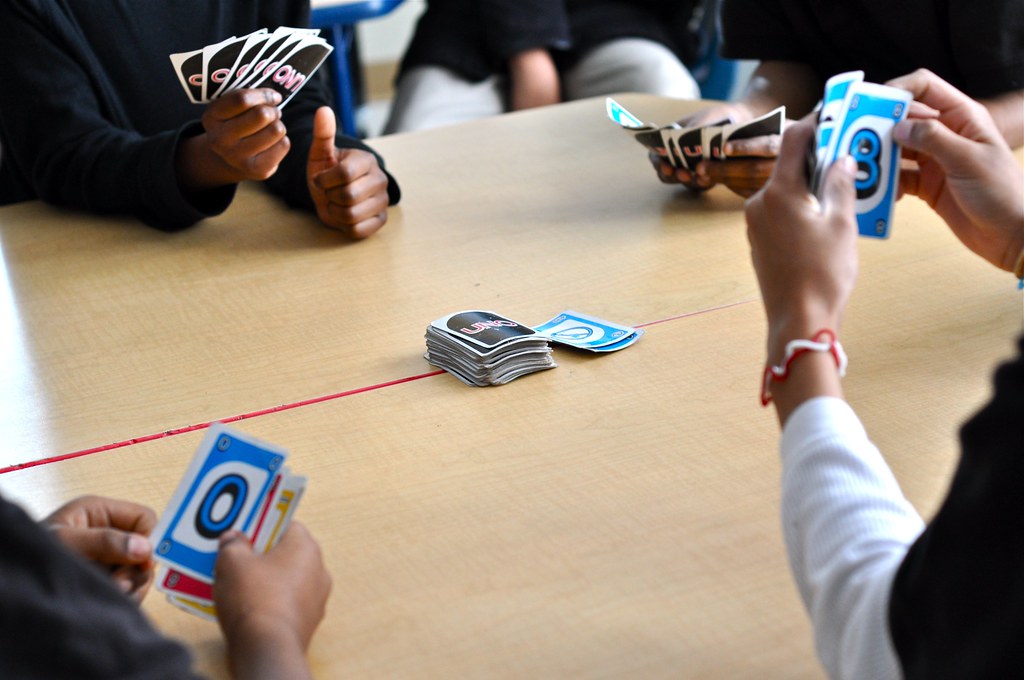
Uno was always my review card game of choice - until I discovered the magic and ease of ¡Pesca!
Out of everything I have tried over the years, here are a few resources and activities that have been successful to review and practice the numbers in Spanish. These are ready-to-go activities that you can use this week if you'd like... or today in the next class period, if you are quick on your feet. (You probably are, if you are a teacher.) These are things I have used successfully in classes with a wide range of levels and experience: from students fluent in Spanish to students who are in the first Spanish class of their life.
 . My father in law gave me a CD last year for Christmas, after I explained this lesson to him.)