Saturday, September 19, 2015

¡Hola hola, Coca Cola!

I just survived the second week of school, and am recovering with a Saturday morning cup of coffee. I've never felt so unprepared for the school year - even two weeks in! Luckily the first weeks of the school year are a chance to incorporate simple class routines that don't necessarily rely on all the little details being in place. (Like supplies... keys to classrooms... access to printers... access to technology... access to curriculum...)

Calling the attention of the class is one of those tiny things that makes a big difference in classroom management. In the past I've tried several things:

  1. Counting down in Spanish.
  2. Patterns of claps or snaps.
  3. "¿Clase?" and "¿Sí?"
  4. A rain stick (which was fun, but quickly fell by the wayside when I became a traveling teacher again!)
Training kids to recognize these and being consistent is probably the most important part of any quiet signal, but I'm always trying to find ways to incorporate authentic language and culture into classroom routines. Halfway through last year I found this fun list of rhymes and started using those with my younger classes. They were so much fun that this year I'm using these as my attention signals with everyone. Here is the list I use, and some bigger signs that I use as cues. (They just have the first part of the rhyme and a picture, as a cue for the response.)

I love these because they are more authentic and interesting than my other methods. (My native speakers can repeat many of them the first day.) Also, I've found that "quiet signals" are universally more interesting if there is some intrinsic motivation to stay quiet - for example, waiting to see what the next rhyme may be!

Do you have any rhymes to add to this list?


Sunday, August 30, 2015

Middle school Spanish grades: Big picture musings and small scale plans

It's August! Not only that... it's the end of August! Teacher week starts tomorrow. I meant to post more during the summer. I have been doing a lot of planning and reflection this summer, but none of that translated into blogging. We've also been moving into our brand new building, which is very exciting (and very time-consuming!)

I've been meeting with the middle school team this summer to plan for the year. We have several new teachers on the team, a brand new building, and a lot of new changes to plan for. We've been talking about grades, and I've been trying to figure out how to align our school-wide policies with my Spanish class policies.

My big-picture grading philosophy can be narrowed down to the following:

Grades should show students, teachers, and parents what students have learned and what they need help on.


That's it! Despite our educational system today which is very focused on numbers and scores, I don't believe students should be narrowed down to static numbers. My teaching shouldn't be narrowed down to numbers. And yet so much of my time is spent on numbers. During those marathons of final grades, I lose myself as a teacher and even as a human, and become GradeBot - typing numbers into little boxes. I want to make sure those numbers are at least meaningful.

GradeBot is usually fueled by coffee. So much coffee.
Here are a few of the big-picture grading questions I've been asking myself:

  • How can I make sure my grades allow for and show growth across all language levels in my classes? My classes include a wide range of students - bilingual students who are also biliterate, native speakers with little exposure to the written word, students from immersion schools, students who I had last year, students who are brand new to Spanish, students who are pulled from half or all of my classes due to IEPs, and everything in between. I want my students to grow from wherever they are at, and I want my grades to reflect that. 
  • How can I make sure my grades reflect what students know and can do in Spanish, not just completion and effort? Participation, effort, and work completion are all very important in language learning. I think it's important that students are rewarded for hard work. However, when students earn points based just on whether they've attempted, it doesn't give anyone (teachers, students, or parents) a very clear idea of exactly what skills they have mastered. Last year I was doing a lot of research and thinking about Standards Based Grading. I think it's important for grades to show what students can do in Spanish, and SBG seems like a logical way to do that. I also would love to see a shift away from letter grades and percentages to grades that show how well students have mastered specific objectives. (Our elementary grades use the Common Core 1-4 grading scale, for instance.) However, as a team we aren't quite ready to make that jump, at least not this year among all the other big-picture changes that are happening. So in middle school, we'll be using a more traditional point system again.
  • How do I make sure assignments are meaningful and not just empty points? Homework in particular is tricky in this sense. I want students to practice outside the classroom, but it's hard to regulate that. If homework or classwork is not meaningful, only the students motivated by those points will do it - and might not be learning much from it anyway.
  • How can I make sure grades are easily understand by both students and parents? At the end of last school year a disappointed parent was unhappy that her daughter did not get perfect grades in Spanish. She commented that she thought I must be giving the good grades to "all the Hispanic kids." I'm trying to use my gut-punch feeling as impetus - I want to have a very clear vision and justification for my grading system, that I can share with parents and students. (In reality, as a general group my native speakers had a wildly varying range of grades.)
  • How do I best use my grading time? I'll be teaching eleven different classes this year, across grades 3 through 8. We've increased Spanish time in all grades - which is wonderful! - but that means that my schedule is pretty packed. I need to use my grading time wisely. I don't need to grade every single thing my students do. How do I plan out exactly what I will be grading in a smart way that lets us all (teacher, parents, students) know what students can do?
  • How do I teach from a textbook in a meaningful way? This is a little bigger than just a grading question. This year is the first year I will be teaching with a textbook in middle school. We just got Avancemos (Level 1) for middle schoolers. I'm excited about the structure and resources it offers - after seven years of making everything from scratch, from curriculum maps to daily lessons to assessments, K-12! However, I want to use the textbook as a tool, not as a crutch.

As I've been pondering these things, I've had some great insight from other language teachers:


So how is this going to play out this year?

In middle school, we've agreed on three weighted grade categories:

  • Homework/Classwork (30%)
  • Assessments (20%)
  • Projects (50%)

For me, this is what that will look like in my middle school grade book:

  • Homework/Classwork: Participation is so important in a language class - and a tricky thing to keep track of! This year I'm trying to focus my participation grades in two ways:
  • Assessments: I like that Avancemos has a variety of differentiated assessments for their units. I'm not sure how many of these I'll actually have - I'm still waiting on the curriculum materials. I like that this is only 20% of the grade - I prefer to see what students can do through projects, but it's nice to be able to hone in on specific skills too. This is a good category for students and parents to see a breakdown of specific skills.
  • Projects:We are a project based school, though this is definitely an area of growth, especially in middle school. We are still trying to figure out how to create meaningful cross-curricular projects, and I think we'll be spending a lot of our professional development time on this. (We have half days every Wednesday to leave PD time in the afternoon.) I have ideas that I'm excited about, but I'm not sure how much planning time I'll get with other teachers this year. Within middle school Spanish classes, however, I will have a variety of projects. Because this is 50% of their grade, a lot of things will fit under this umbrella:
    • Planning activities
    • Project check ins (to check student progress throughout the project)
    • Final project grades (with a rubric connecting the project to our objectives)
    • Presentations
    • Reflections
Now... how to put this into a syllabus in a condensed way...

Tuesday, June 9, 2015

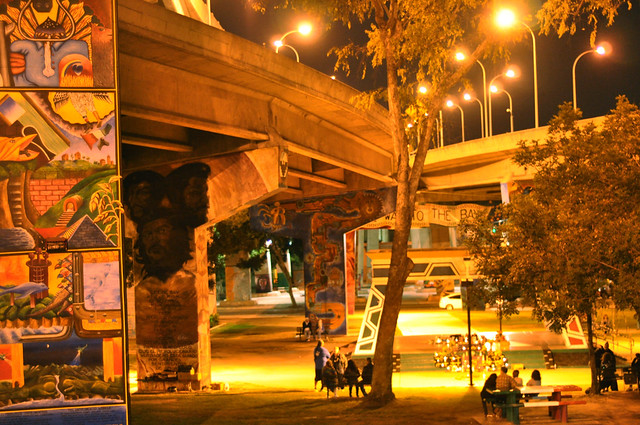
Chicano Park

Untitled
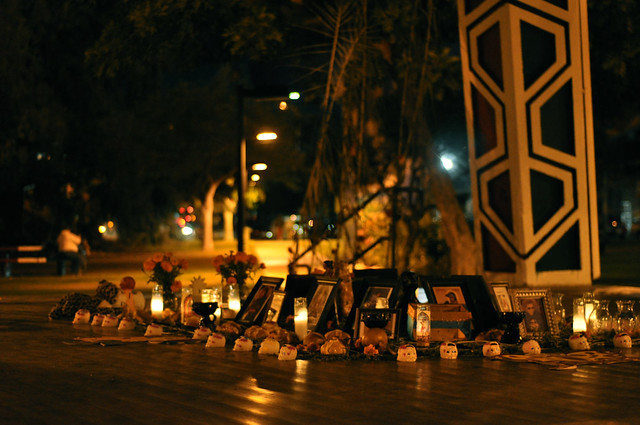
Chicano Park - Día de los Muertos, 2014 (My first visit to the park.)
Earlier this month I had the chance to go with the 6th graders to Chicano Park here in San Diego. The field trip was part of a really cool cross-curricular Social Justice project that they were doing in their other classes. Next year I want to integrate a lot more connections in my Spanish class, but I was really excited to go along this year, and I want this to be an ongoing part of my Spanish curriculum.

Back in Detroit, I collaborated with the art programs at both schools I worked at, to take field trips to the Detroit Institute of Art, especially to see Diego Rivera's mural. It's an amazing mural with significant ties to local history and culture, and I was sad to leave it behind when I moved to California.

Since I moved to San Diego in August, I've been looking for local opportunities. Chicano Park has an amazing history and is the perfect place for students to learn about art, the local Spanish-speaking community, our identity as a border town, alternative histories, and an inspiring example of grassroots movement and personal activism that they are studying through their Social Justice project.


We got a great tour by members of the park's steering committee. My group was led by Victor Ochoa, one of the muralists. I learned as much as the kids did!

Before going on the field trip, I made this scavenger hunt for the kids. They looked for the phrases around the park and matched them to the murals they were included on, and then later in Spanish class we translated them and connected each phrase to the history we had learned about. (The file includes an answer key. I made it using images from this documentation project, but I already know I'll be updating it with more images and phrases later on.)

https://www.dropbox.com/s/h8ejmkpztb8hrdu/Chicano%20Park%20Phrase%20Scavenger%20Hunt.docx?dl=0

As a follow-up project, students are researching and presenting information about people from the Spanish-speaking world. This includes famous Hispanic figures, some relatives and family members, and people they learned about during the field trip. I used one of the murals from Chicano Park as a starting point for this project, and created a Thinglink for students to explore the people and symbols pictured.


This year, the field trip, subsequent project, and curricular connections were all somewhat hasty, in the midst of end-of-the-year chaos and the general upheaval of establishing and refining a new program at a new school. I have high hopes for next year, however, and am excited to do more.

The Chicano Park Steering Committee was so helpful in coordinating and leading our tours. They have a website at www.chicano-park.com.

For local educators - if you have led field trips to Chicano Park or would like to in the future, I would love to hear more about what you have done, share resources, and collaborate!
Untitled
Chicano Park - Día de los Muertos, 2014

Sunday, May 24, 2015

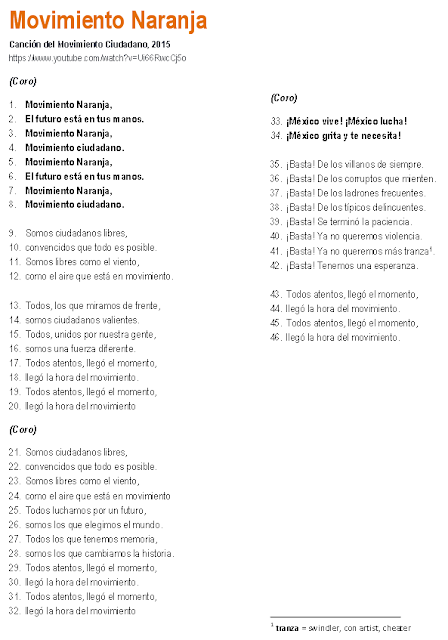
Movimiento Naranja - Movimiento Ciudadano

I haven't posted much here recently. I've been busy with some exciting things (working to expand the Spanish program at our school, lots of cross-curricular planning for next year, and some end-of-the-year projects with the middle school students.)

Every year at the end of the year, I find myself trying to do things that are too complex and too long for the inevitable chaos of end-of-the-year schedules, where student and teachers alike are affected by state testing, field trips, camps, absences, and (in my case recently!) immune systems that are succumbing to end-of-the-semester stress. I'm excited about some of the projects my middle school students are doing - but a little hesitant to share before I see how they turn out.

However, I want to use this blog to reflect on what I'm doing, and to share what is working - so I'm attempting to do that, even in these last crazy weeks of the school year! Here's something that may be useful to you as the school year winds down.

Here's a song that I heard on the radio* a few weeks ago. It was so catchy that I immediately looked it up. As it turns out, it is a promotional music video for a Mexican political party.


As a disclaimer: I am not promoting this political party or any of their campaigns. But I am congratulating them on writing a simple, catchy song with a feel-good music video that includes lots of beautiful images of Mexico. There are quite a few familiar shots for my students and I - the border fence, and scenes from our neighboring city across the border, Tijuana.

I've used this for some grammar practice in middle school, and played it for my younger students to wrap up our Mexico-focused lessons about Cinco de Mayo. (It's a good "get the classroom cleaned up" song, too.)

Thanks to the folks in the Spanish Teacher Share group on Edmodo for helping me find and correct the lyrics! Here they are, with several different activities I did with my students:
  • Cognates: Matching translations (to lines with lots of cognates)
  • Grammar/Conjugation: Ser, Estar, and Tener conjugations
  • Advanced: What does this song tell us about the party's political platform? (Led to some interesting discussion of political propaganda in middle school.)
If you find any errors in the lyrics, let me know!  Also, I haven't been able to find the name of the artist who wrote the song - do you know?


https://www.dropbox.com/s/12dcw0be2l1xvbx/Movimiento%20Naranja.docx?dl=0


*Side note: Since moving to San Diego, I've discovered a new hobby: Listening to Mexican political ads awkwardly translated into English, on the English stations broadcast from Tijuana.

Saturday, April 18, 2015

Culture in 3 Acts: Semana Santa

I started rethinking some of my cultural lessons after a colleague presented about Three Act Mathematical Stories. After getting back from break I applied the concept to a cultural lesson about Semana Santa.

My main goal was to create a very student-driven exploration of culture. The ACTFL standards ask students to explore the connections between products, practices, and perspectives of the target culture, but it's often up to the teacher to select which products, practices, and perspectives to focus on. With a large range of options, how do we choose which are most relevant and important to share with our students? One option is to let students direct the focus of those explorations. Here's how that worked out in my classes this week.

Here's a copy of the guided notes I used with my class during this assignment.

Saturday, March 21, 2015

Games for review and practice: Two great resources

This coming week my middle school students will be taking some quizzes - a vocabulary quiz on verbs for interests and pastimes for 6th grade, and a ser vs. estar quiz for 7th and 8th grade. Both quizzes will be taken and graded online (thanks to Google Forms and Flubaroo) but in class we have also been using some fun digital tools for review and practice!

At the beginning of the school year, I focused a lot on individual learning styles and ways to practice that work for each individual. More recently, our focus has been on group work. Our school's virtue of the month for March is Cooperation, and this is a good time to find ways to learn together, with lots of group explorations and assignments. Our review for upcoming vocabulary and grammar quizzes has also been in groups, using two review games:


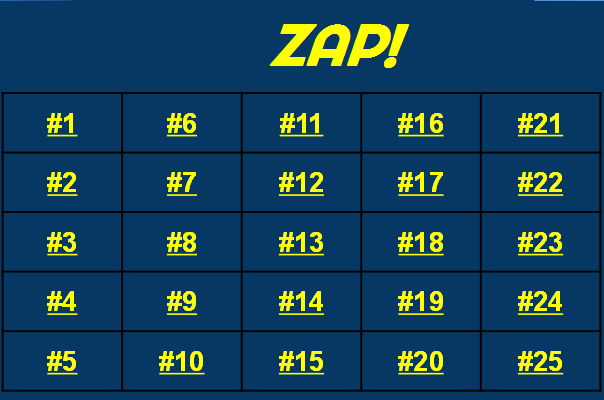
Activity: ZAP


How I used it: 
I put students in groups and gave each group two whiteboards. I asked the class a review question (normally the translation of a vocabulary word or a sentence.) The first group that had the answer up (and correct!) got to choose a number from the Zap board - and scores were changed accordingly!

Will probably work well for:
  • Spur-of-the-moment practice - all you need is the online template, and whiteboards. 
  • Groups with good teamwork and generally good behavior, and who love a competition! 
  • Student-chosen groups, since the end scores are less a result of correct answers and more a result of blind luck (based on the numbers chosen!)
Will probably not work well for: 
  • Any classes that are already loud and chaotic, since this can get pretty crazy - especially with the random swapping of scores!

Tips for success:
  1. To make sure everyone gets a chance to participate, require that students rotate the board among their group members - or require that all team members have a board and all have the correct answer!
  2. Require students to request numbers in the target language.
  3. If groups are too chaotic, play with individual students, each with their whiteboard, and randomly select a student each round to give their answer. (Choose from a jar of sticks, etc.)

Activity: Flippity.net Quiz Show

How I used it: 
I used Flippity's amazing template to created leveled questions related to what we were studying - Verbos y Opiniones and Ser vs. Estar. It is time consuming to come up with 30 separate items, but once you type the questions and answers into the online template, it automatically creates a Jeopardy-style quiz show. You click on the numbers to pick questions in each category and difficulty level, and click buttons to choose teams that answered correctly or incorrectly - the site keeps track of scores automatically. (You can add or delete teams, edit team names, and adjust scores as needed - for example, I give bonus points for the first teams ready to play, and take off points for things like off-task behavior or misuse of supplies.)

Will probably work well for:
  • Mixed level groups: I made sure to distribute my native speakers evenly throughout my teams.
  • Carefully leveled items: I put items using new vocabulary (or that included written accents and other common mistakes even for my native speakers) in the 500 spaces.
  • Test preparation: You can even try out some new test items.
Will probably not work well for: 
  • Spur-of-the-moment practice, since you need to create the questions.
  • Student-chosen groups, if you have a wide variety of language levels in one class.
Tips for success:
  1.  Make sure every member of the team writes down the answer correctly - this requires the groups to check in with their team, and makes sure everyone is getting practice (even if one team member is significantly stronger in the language.)
  2. Don't have teams hold their boards up right away, or it's too easy to copy other scores. I give a countdown to finish up, and ring a bell. You can also randomly choose a team member to show you their board. (It's pretty easy to sneakily add a missing letter or accent!)
Flippity also includes some great resources to create online flashcards and other tools, using Google sheets as templates.You can check out the resources I have already created with this tool, or easily create your own. Huge thank you to Steve Fortna for creating this resource, and to Ashley Fulks for passing it on!

    Monday, March 2, 2015

    Yo tengo / ¿Quién tiene? (Descripción Física)

    I like using Yo Tengo / ¿Quién tiene? activities as a quick way to practice pronunciation, and an informal, low-stakes way to formatively assess individual pronunciation.

    Recently I have been using this set with my 6th graders, who are practicing the physical description vocabulary we have been working with. This focuses on noun-adjective agreement (with the colors.)

    Yo Tengo / ¿Quién tiene? - Descripción Física

    (I cut each page into three narrow strips, and  laminated them to make them more durable.)

    (All images are clip art found via Google image search.)


    Hope it can be useful!

    For those who have not used this type of activity before: