Saturday, December 19, 2015

A quick translation project and a long reflection

At my school we've been working hard on Project Based Learning (PBL) and how to implement it effectively in our school. There are plenty of school-wide challenges, like constructing quality projects within the constraints of fairly traditional schedules and staffing, and a national educational climate that still requires focus on specific national standards measured by high-stakes tests.

As a language teacher, I've been struggling with PBL and how that fits with what I know about developing language proficiency. Within the constraints of my schedule (two 40-60 periods per week, depending on grade level) I feel like I constantly have to choose my focus:
  • Teaching entirely in the target language or creating student-driven, inquiry-based lessons
  • Project based learning vs. language immersion
  • Creating decent lessons for 6 different grade levels vs. creating a few great lessons
I know I'll get better at this with time, and it helps to be collaborating on PBL with others. I think for now I need to accept slow progress - which is hard for me. I've been averaging 60 hours per week just inside the school building (plus more at home) just planning and grading work that I know is subpar, from a language proficiency perspective. Compromising professional work quality for any kind of work-life balance is nothing new, but I do feel fortunate that I work with administrators who understand our constraints (rather than just creating more) and who are willing to give teachers space to grow within those constraints - there are definitely places where that is not the case. 

All of that to say: I've been thinking a lot about meaningful projects, and getting discouraged because they seem beyond my grasp.

However, one quick project I did with 7th and 8th grade this month was a bright spot... especially because it was the product of a spark of an idea while driving home one night and a few frantic hours of preparations in order to start the next morning!


This year some parents and staff at my school collaborated with a local charitable organization to collect donations of socks and toiletries for those in need in our community. Ideal projects address a real need in the community - which is tricky when it comes to unit planning, since sometimes real community needs don't fit into curriculum maps. I figured that an opportunity to create something real world and authentic was more worthwhile than spending our last class periods wrapping up weather review and holiday-related cultural lessons. So I threw together a translation project that could fit into two class periods. I'm pretty happy with the results - more so than some projects that have taken far more planning and class time.

This is what we did, how I would change this for the future, and maybe even some ideas for you.

Thursday, December 17, 2015

2 Anuncios Navideños

I'm guessing most of you teachers in the US have one more day left before break. Here's a quick listening activity using two holiday ads from Spanish-speaking countries.

(Kids might need some hints for figuring out the country for the first video - this article listing the many names of a mysterious gift-bearing man might contain a clue!)

Enjoy!

Anuncio 1: ¿Cómo se escribe...? (Jumbo)

Anuncio 1: ¿Cómo se escribe...? (IKEA)

Sunday, December 13, 2015

Quick linguistic comparison: Spanish vs. Arabic

About a year ago I shared the Ocho Kandelas song in Ladino as a quick lesson tying together Spanish history, linguistic comparisons, and Hannukah traditions. This year I'm using this song again, but am also sharing this quick video comparing Arabic and Spanish:


Here's a listening worksheet I made for with the video. (Any readers who speak and write Arabic, feel free to correct my Arabic transcriptions... I used wordreference and my dubious familiarity with the Arabic alphabet.)


This quick look at Ladino and Arabic have been a quick a chance for my students at all grade levels (3rd through 8th) to see how knowing one new language can help them with understanding others. It ties in well with our discussion of historical religious conflict in Spain, and even current events. (I've tried very hard to remain politically neutral, but when I told them about Jews and Muslims being kicked out of Spain, an entire 3rd grade class started yelling about a certain political candidate who is big in the news these days...)

I love nerding out about language learning with my students! I've been trying to learn Arabic for a few years, as my third language - not rigorously enough to gain any kind of fluency, as I learned during a trip to Morrocco where the only phrase I could consistently remember was an unhelpful "She drinks coffee." Maybe this lesson will give me the push I need to pick up my language studies again. I find it very meaningful to be a language learner along with my students.

Edit: Just read the news about Augusta Co. schools. Be careful where you teach this - yikes!

Saturday, November 28, 2015

Crossover vs. Computer (Spanish Teacher vs. Online Translators)

At my school middle school students have Google accounts through the school, and access to chromebooks. Although I consider myself to be pretty tech savvy, this is the first time I've been at a Google school and the first time my students have really had reliable access to technology. Overall that's a huge benefit - there are so many amazing digital tools available for both teachers and students. However, learning to use them productively and responsibly has been a learning curve for all of us. As a language teacher, I've had to balance the benefits of these digital tools with the strong temptation of one tool in particular - Google Translate. When beginning students hit the wall of their language limitations, it's easier to take the easy way out. Last year I dealt with many individual cases of students using online translators, and I realized I needed to be more proactive this year.

This year I made sure I included a note about online translators on my syllabus, and explained that for language learners this is a form of academic dishonesty.


However, I wanted to go deeper than that. Beginning language learners turn to easy shortcuts like Google Translate because it's quick, but because it seems like a viable solution when they can't produce the language they want. To all appearances the computer knows more language than they do. However, even a beginning learner will make different errors than a computer. I wanted to show students the awkwardness of computer translation, and why it's pretty easy to spot.

To do this, I found songs that had been released in English and in Spanish - Perdón by Enrique Iglesias & Nicky Jam and Tengo tu Love by Sie7e. (Links are to PDFs that I used.)I gave students a side by side comparison of some of the verses: the Spanish version, the English version, and a Google translation of the Spanish into English.

I asked students to examine each set of lyrics and think about which lines were translated awkwardly by Google Translate, and what changes the artist made so the lyrics worked better in a new language (or new culture.) Songs are a great way to highlight why exact translation sounds clunky. "Ricky Martin's got the looks" is catchier than the literal "Ricky has cute face," and sometimes crossover artists leave some simple lines untranslated - because eso no me gusta, eso no me gusta just sounds better!

The students had fun with this activity and it was a great way to talk about translation with them. As they were working on their pen pal letters over the following days, I overheard several encouraging comments.

"No, don't use Google Translate! Dude, we just did a whole activity about this!"

Any other fun examples of awkward translations? Here's an interesting news article about a Spanish town's reliance on Google Translate that got very awkward (though I'm not quite ready to go into that vocabulary realm with my middle school students.)

Side note: I had the chance last week to go to ACTFL here in San Diego, which was great.. but even after a whole week of break I haven't managed to finish processing the massive amount of ideas, notes, questions, resources and professional connections from the conference. More on that later!

Monday, November 9, 2015

Tarea Mensual: What middle school homework looks like this year

The short version of this post:

Here's a copy of my monthly homework options for middle school Spanish students! Tarea Mensual: Differentiated Spanish Homework Options (It's my first resource posted on Teachers Pay Teachers, and it's free!)

And for those of you who want to hear about how and why I put together this resource...

I spent a lot of time over the summer thinking about homework in middle school Spanish. (I rambled a bit about this over here.) At EdCamp this year I had the chance to hash(tag) this out at a great discussion with Alice Keeler. I don't feel as a language teacher I can give up on homework if I really want kids to be proficient - class time just isn't sufficient for learning a language. However, I do need to make sure homework is manageable and meaningful.

As a teacher, "dream homework" would do all of the following:

  • Homework should get kids to use Spanish outside the classroom - including reading, writing, listening, and reading, at appropriate levels. (That's the tricky part!)
  • Homework needs to be accessible for all my levels of students - from beginners to native speakers.
  • Homework needs to be engaging, relevant, and enjoyable (so that kids wantto do it.)
  • Homework shouldn't rely on internet access. We are using Google Classroom this year, which makes assignments so much simpler from my point of view - and for most of my students. However, not all my students have internet access. 
  • Homework shouldn't make or break a grade. Kids have wildly varying home situations and access to support. It's not fair for me to rest an entire grade on something I can't help students with.
  • Homework should not take over anyone's life. This applies to both students and teachers! Even in middle school, homework can start to take over - especially for the students who care about their grades and care about completing their homework, who in many cases are also the ones involved in extracurricular activities. I also can't let homework take over mylife - I have so many students, and I want to spend my time planning and assessing projects, not homework!
With all this in mind, and inspired by the homework choices over at Musicuentos,I started the year with weekly homework options to choose from. Students were to choose one or a combination of activities from a list, and turn in a report at the end of the week via Google Classroom. Those first two weeks were a little chaotic. Remember how homework shouldn't take over anyone's life? Homework took over my life. Students were confused about the report format (a normal learning curve, perhaps) and most of them just emailed me screenshots or questions, swamping my email inbox with emails. With the option of choosing a variety of 1 pt, 3 pt, and 5 pt activities, students all wanted to do the harder 5 point activities for more points - though these were often too hard for them. (Lead Us Not Into Google Translate Temptation.) I made some necessary adjustments that I think were important. 
  • Students get a grade based on whether they complete a variety of activities and submit proof. Activities are not assigned individual point values. I don't assign point values to any particular activity (since kids were tempted to go for the more "valuable" activities, when often these were not appropriate for their level.)
  • Students turn in one report at the end of the month, describing what activities they did that month. Weekly reports were just too much, for me and my students. Students need 4 activities for the month, but they can complete those at their leisure.
  • Students have some class time near the end of the month to complete the reports via Google Classroom. This makes the assignments more accessible to students who lack computer access at home, or who are less tech savvy... or who just aren't going to remember to turn in their report on their own.

So far I've gotten positive feedback from students. They've enjoyed picking activities themselves, and some have found resources they really enjoy. (Lyrics Training and Free Rice are some favorites.) So far I've rolled out this homework with 7th and 8th graders (3 classes in all) and I have found it fairly manageable as far as grading goes - using Goobric and Doctopus* for my workflow, I've been able to grade the homework for one class in 45 minutes (including individual comments.) That's not too bad for monthly homework!

We'll see how this evolves! I'd love any feedback and suggestions if you've done something similar with your students, or if you find this useful for yourself!

*Please do let me know if you'd like to know more about how I've streamlined my grading process with these tools!

Tuesday, October 27, 2015

Día de los Muertos - Resources you can use tomorrow

I'm finishing up some sub plans for upcoming absences, and let's be honest - this is the time of year where many teachers need some sub plans even if they aren't going to be absent. By that I mean: you're so swamped by parent emails, test administration, professional learning, and preparing for parent conferences that planning time is limited. (Also, Halloween is coming up this weekend, so kids are going to be a little distracted.)

I feel fortunate because as a Spanish teacher, I can use this time of year for some cultural lessons connected to Day of the Dead - something that's meaningful and engaging, even for burned out teachers and sugared up students.

I figured I'd reshare one of my favorite and most versatile Día de los Muertos resources - this brief digital short that's touching, really encompasses a lot of traditions, and is engaging for all ages. (I've used it successfully from everyone K-8.)


Some things you can do with this video:
  1. Focus on listening and reading! Learn more about Movie Talk here (including a demo by Martina Bex.) See some slides with stills that I put together to talk through the story (it was just clearer than pausing the video for me.) I also use a written text with vocabulary questions at the end. (I started with Dustin Williamson's as an example, but changed it to present tense and edited it to make it fit with my students' needs.) 
  2. Cultural focus: Show the video as an intro to the traditions involved in Día de los Muertos and have students compare and contrast it with traditions in their own families. Here is a packet of information I've used.
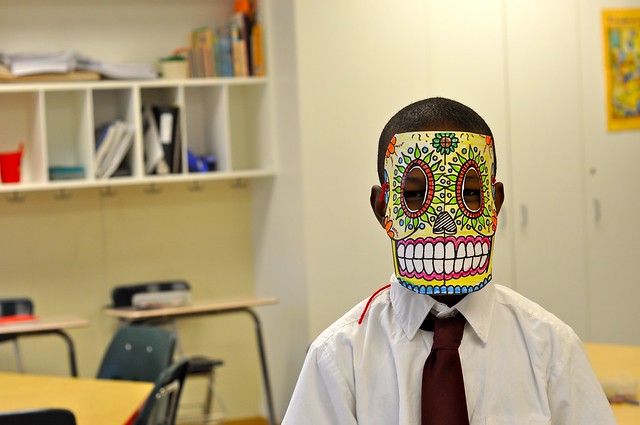
  3. Follow up: Depending on how much time you want to spend and the grade level of your students, follow up with one of these resources or a simple calavera mask using one of HappyThought's free templates or the one from AZ Central's teacher packet.

¡Buena suerte!

Día de los Muertos
A mask using AZ Central's template.

Sunday, October 25, 2015

Calaverita - La Santa Cecilia

It's that time of year again!

Untitled
Chicano Park - Día de los Muertos, 2014

I have some absences coming up due to training, jury duty, and out of town weddings, and so I'm trying to come up with sub plans that are engaging. Luckily, it's Day of the Dead season, and there are lots of resources out there! Last year I shared some of the resources I've used, and a list that I've added to since then.

I just bought the Book of Life movie, which was released last year. I'll be leaving that with my sub plans. While researching resources for the film, I stumbled across a newly released song by La Santa Cecilia from nearby Los Angeles. I'm definitely going to use this to introduce the holiday and set the stage for when I'm gone.


I love so many things about this video. It includes many traditional Día de los Muertos symbols, as well as some not-so-subtle references to current events (did you catch Zombie Trump?) Most importantly, it conveys the spirit of the holiday and the underlying attitudes toward death.

It was Kara Jacobs who pointed me to this song and compiled several great resources. I will be using a revised version of the lyrics she posted, with questions that fit with my diverse student levels.

If you'd like a copy: Google doc here, or as a PDF here.